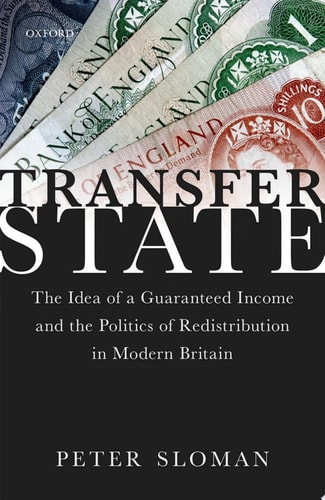
Transfer State: The Idea of a Guaranteed Income and the Politics of Redistribution in Modern Britain
0
0
As an Amazon Associate and affiliate partner, Menrva Books earns from qualifying purchases. Learn more
Author Description
The idea of a guaranteed minimum income has been central to British social policy debates for more than a century. Since the First World War, a variety of market economists, radical activists, and social reformers have emphasized the possibility of tackling poverty through direct cash transfers between the state and its citizens. As manufacturing employment has declined and wage inequality has grown since the 1970s, cash benefits and tax credits have become an important source of income for millions of working-age households, including many low-paid workers with children.The nature and purpose of these transfer payments, however, remain highly contested. Conservative and New Labour governments have used in-work benefits and conditionality requirements to 'activate' the unemployed and reinforce the incentives to take low-paid work - an approach which has reached its apogee in Universal Credit. By contrast, a growing number of campaigners have argued that the challenge of providing economic security in an age of automation would be better met by paying a Universal Basic Income to all citizens.Transfer State provides the first detailed history of guaranteed income proposals in modern Britain, which brings together intellectual history and archival research to show how the pursuit of an integrated tax and benefit system has shaped UK public policy since 1918. The result is a major new analysis of the role of cash transfers in the British welfare state which sets Universal Credit in a historical perspective and examines the cultural and political barriers to a Universal Basic Income.
Menrva's Summary
THE THESIS
How has the concept of a guaranteed minimum income influenced the trajectory of British social policy and the politics of wealth redistribution since the First World War? Peter Sloman, a historian of modern British politics, utilizes extensive archival research and intellectual history to trace the evolution of cash transfer systems. He argues that the tension between conditional welfare, such as Universal Credit, and the proposed Universal Basic Income reflects deep-seated cultural and political disagreements regarding the state's role in providing economic security.
THE SCOPE MAP
What You Will Find
- A historical analysis of guaranteed income proposals in Britain from 1918 to the present.
- An examination of the transition from manufacturing-based employment to modern wage inequality.
- A comparative study of Conservative and New Labour approaches to welfare conditionality.
- An investigation into the political and cultural barriers preventing the adoption of Universal Basic Income.
THE AUTHORITY PERSPECTIVE
Experts recognize this work as a definitive historical account of the British welfare state's development regarding cash transfers. Readers frequently note the academic rigor and the clarity with which the author contextualizes contemporary debates like Universal Credit within a century of policy evolution.
Page Count:
320
Publication Date:
2019-12-24
Publisher:
Oxford University Press
ISBN-10:
0198813260
ISBN-13:
9780198813262
Politics
History
Economics
Public Policy
Basic income
Social policy
Great Britain
Community Tags
Similar Books