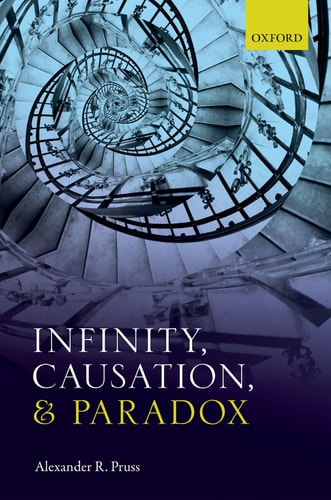
Infinity, Causation, and Paradox
0
0
As an Amazon Associate and affiliate partner, Menrva Books earns from qualifying purchases. Learn more
Author Description
Infinity is paradoxical in many ways. Some paradoxes involve deterministic supertasks, such as Thomson's Lamp, where a switch is toggled an infinite number of times over a finite period of time, or the Grim Reaper, where it seems that infinitely many reapers can produce a result without doing anything. Others involve infinite lotteries. If you get two tickets from an infinite fair lottery where tickets are numbered from 1, no matter what number you saw on the first ticket, it is almost certain that the other ticket has a bigger number on it. And others center on paradoxical results in decision theory, such as the surprising observation that if you perform a sequence of fair coin flips that goes infinitely far back into the past but only finitely into the future, you can leverage information about past coin flips to predict future ones with only finitely many mistakes.Alexander R. Pruss examines this seemingly large family of paradoxes in Infinity, Causation and Paradox. He establishes that these paradoxes and numerous others all have a common structure: their most natural embodiment involves an infinite number of items causally impinging on a single output. These paradoxes, he argues, can all be resolved by embracing 'causal finitism', the view that it is impossible for a single output to have an infinite causal history. Throughout the book, Pruss exposits such paradoxes, defends causal finitism at length, and considers connections with the philosophy of physics (where causal finitism favors but does not require discretist theories of space and time) and the philosophy of religion (with a cosmological argument for a first cause).
Menrva's Summary
THE THESIS
This book investigates whether the paradoxes arising from infinite sequences can be resolved by the principle of causal finitism. Alexander R. Pruss, a philosopher known for his work in metaphysics and the philosophy of religion, argues that the common thread linking various logical and physical paradoxes is the assumption that an infinite number of items can causally influence a single output. He defends the thesis that such infinite causal histories are impossible, proposing causal finitism as a necessary framework for resolving these contradictions.
THE SCOPE MAP
What You Will Find
- Analysis of classic paradoxes including Thomson's Lamp and the Grim Reaper.
- Exploration of infinite lotteries and decision theory anomalies.
- A defense of causal finitism as a solution to infinite causal chains.
- Connections between causal finitism, the philosophy of physics, and cosmological arguments for a first cause.
THE AUTHORITY PERSPECTIVE
Experts in metaphysics and analytic philosophy recognize this work as a rigorous contribution to the debate surrounding infinity and causality. Readers frequently note the technical density of the prose, which requires a strong background in formal logic and philosophical argumentation.
Page Count:
224
Publication Date:
2018-10-16
Publisher:
Oxford University Press
ISBN-10:
0198810334
ISBN-13:
9780198810339
Philosophy
Logic
Causation
Infinite
Paradox
Metaphysics
Finite The
Community Tags
Other Editions(2)

Similar Books