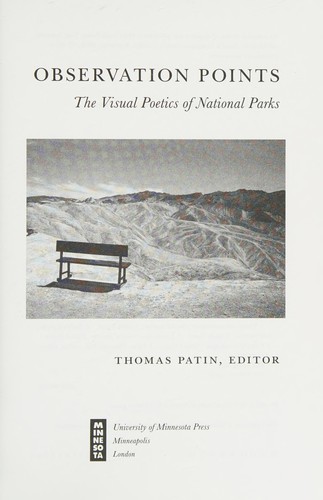
Observation Points
0
0
As an Amazon Associate and affiliate partner, Menrva Books earns from qualifying purchases. Learn more
Author Description
National parks are the places that present ideas of nature to Americans: Zion, Yosemite, Grand Canyon, Yellowstone bring to mind quintessential and awe-inspiring wilderness. By examining how rhetoric--particularly visual rhetoric--has worked to shape our views of nature and the "natural" place of humans, Observation Points offers insights into questions of representation, including the formation of national identity.As Thomas Patin reveals, the term "nature" is artificial and unstable, in need of constant maintenance and reconstruction. The process of stabilizing its representation, he notes, is unavoidably political. America's national parks and monuments show how visual rhetoric operates to naturalize and stabilize representations of the environment. As contributors demonstrate, visual rhetoric is often transparent, structuring experience while remaining hidden in plain sight. Scenic overlooks and turnouts frame views for tourists. Visitor centers, with their display cases and photographs and orientation films, provide their own points of view--literally and figuratively. Guidebooks, brochures, and other publications present still other ways of seeing. At the same time, images of America's "natural" world have long been employed for nationalist and capitalist ends, linking expansionism with American greatness and the "natural" triumph of European Americans over Native Americans.The essays collected here cover a wide array of subjects, including park architecture, landscape painting, public ceremonies, and techniques of display. Contributors are from an equally broad range of disciplines--art history, geography, museum studies, political science, American studies, and many other fields. Together they advance a provocative new visual genealogy of representation.Contributors: Robert M. Bednar, Southwestern U, Georgetown, Texas; Teresa Bergman, U of the Pacific; Albert Boime, UCLA; William Chaloupka, Colorado State U; Gregory Clark, Brigham Young U; Stephen Germic,
Menrva's Summary
THE THESIS
This book investigates how visual rhetoric has shaped American perceptions of nature and humanity's place within it, particularly through the lens of national parks. The collection explores the artificial and politically charged nature of the term "nature" itself, revealing how its representation requires constant maintenance and reconstruction. It examines the often-transparent ways visual rhetoric structures our experience of national parks, from scenic overlooks and visitor centers to guidebooks and brochures. Furthermore, it uncovers how these images have historically been used to support nationalist and capitalist agendas, linking territorial expansion with American identity and the subjugation of Native Americans.
THE SCOPE MAP
- Analysis of visual rhetoric in shaping views of nature and human place within it.
- Exploration of the political nature of representing "nature" and its instability.
- Examination of how national parks and monuments use visual rhetoric to stabilize environmental representations.
- Case studies of scenic overlooks, visitor centers, and publications as points of view.
- Discussion of the nationalist and capitalist uses of images of America's "natural" world.
- Inclusion of essays on park architecture, landscape painting, public ceremonies, and display techniques.
- Contributions from diverse disciplines including art history, geography, museum studies, political science, and American studies.
THE AUTHORITY PERSPECTIVE
The essays collected in Observation Points offer a provocative new visual genealogy of representation, drawing from a wide array of subjects and disciplines. Contributors from fields such as art history, geography, and American studies examine how visual rhetoric operates within national parks to shape our understanding of nature and national identity. The collection highlights the political implications of representing the environment and how these representations have been historically linked to nationalist and capitalist agendas. The book is recognized for its interdisciplinary approach and its critical examination of the construction of the American landscape.
Page Count:
0
Publication Date:
2012-01-01
ISBN-10:
0816651450
ISBN-13:
9780816651450
History
Non-Fiction
Science
American Studies
National Parks
Community Tags
Similar Books