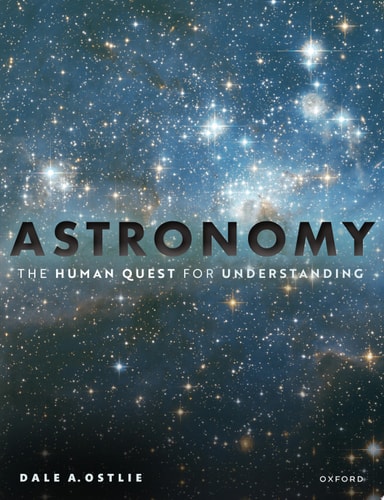
Astronomy: The Human Quest for Understanding
0
0
As an Amazon Associate and affiliate partner, Menrva Books earns from qualifying purchases. Learn more
Author Description
Since humans first looked up at the stars, astronomy has had a particular ability to stir the imagination and challenge the thinking of scientists and non-scientists alike. Astronomy: The Human Quest for Understanding is an introductory astronomy textbook specifically designed to relate to non-science majors across a wide variety of disciplines, nurture their curiosity, and develop vital science-based critical-thinking skills.This textbook provides an introduction to how science operates in practice and what makes it so successful in uncovering nature's secrets. Given that the study of astronomy dates back thousands of years, it is the ideal subject for tracing the development of the physical sciences and how our evolving understanding of nature has influenced, and been influenced by, mathematics, philosophy, religion, geography, politics, and more. This historical approach also illustrates how wrong turns have been taken, and how the inherent self-correcting nature of science through constant verification and the falsifiability of truly scientific theories ultimately leads us back to a more productive path in our quest for understanding. This approach also points out why, as a broadly educated citizenry, students of all disciplines must understand how scientists arrive at conclusions, and how science and technology have become central features of modern society.In discussing this fascinating and beautiful universe of which we are a part, it is necessary to illustrate the fundamental role that mathematics plays in decoding nature's mysteries. Unlike other similar textbooks, some basic mathematics is integrated naturally into the text, together with interpretive language, and supplemented with numerous examples; additional tutorials are provided on the book's companion website.Astronomy: The Human Quest for Understanding leads the reader down the path to our present-day understanding of our Solar System, stars, galaxies, and the beginning and evolution of our universe.
Menrva's Summary
THE THESIS
How does the historical development of astronomy serve as a foundational framework for understanding the scientific method and its role in modern society? Dale A. Ostlie, a seasoned educator in the physical sciences, utilizes a historical and interdisciplinary approach to introduce non-science majors to the cosmos. By tracing the evolution of astronomical thought, the text argues that science is a self-correcting process that relies on falsifiability and rigorous verification. The book aims to equip students with critical-thinking skills necessary to navigate a world increasingly shaped by scientific and technological advancement.
THE SCOPE MAP
What You Will Find
- Historical progression of astronomical models from ancient observations to modern cosmology
- Integration of fundamental mathematical concepts applied to physical phenomena
- Analysis of the intersection between astronomy and philosophy, religion, and politics
- Comprehensive coverage of the Solar System, stellar evolution, and galactic structures
THE AUTHORITY PERSPECTIVE
Educators frequently highlight this text for its accessible integration of mathematics and its emphasis on the scientific process rather than rote memorization. It is widely regarded as a balanced introductory resource for students seeking to understand the broader cultural and logical implications of astronomical discovery.
Page Count:
912
Publication Date:
2022-10-30
Publisher:
Oxford University Press
ISBN-10:
019882582X
ISBN-13:
9780198825821
Science
textbook
Education
Physics
Astronomy
Community Tags
Other Editions(2)
Similar Books


Reader Comments
Share Your Thoughts
No comments yet. Be the first to share your thoughts!