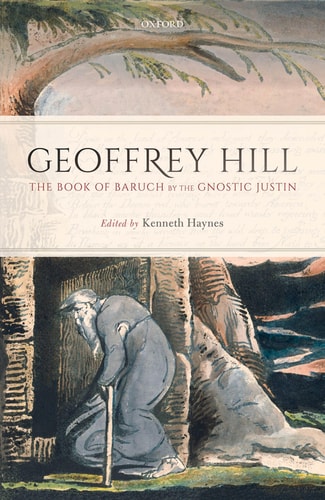
The Book of Baruch by the Gnostic Justin
0
0
As an Amazon Associate and affiliate partner, Menrva Books earns from qualifying purchases. Learn more
Author Description
At his death in 2016, Geoffrey Hill left behind The Book of Baruch by the Gnostic Justin, his last work, a sequence of more than 270 poems, to be published posthumously as his final statement. Written in long lines of variable length, with much off-rhyme and internal rhyme, the verse-form of the book stands at the opposite end from the ones developed in the late Daybooks of Broken Hierarchies (2013), where he explored highly taut constructions such as Sapphic meter, figure-poems, fixed rhyming strophes, and others. The looser metrical plan of the new book admits an enormous range of tones of voices.Thematically, the work is a summa of a lifetime's meditation on the nature of poetry. A riot of similes about the poetic art makes a passionate claim for the enduring strangeness of poetry in the midst of its evident helplessness. The relation between art and spirituality is another connecting thread. In antiquity, Justin's gnostic Book of Baruch was identified as the 'worst of heresies,' and the use of it in Hill's poem, as well as the references to alchemy, heterodox theological speculation, and the formal logics of mathematics, music, and philosophy are made coolly, as art and as emblems for our inadequate and perplexed grasp of time, fate, and eternity. A final set of themes is autobiographical, including Hill's childhood, the bombing of London, his late trip to Germany, his alarm and anger at Brexit, and his sense of decline and of death close at hand. It is a great work, and in Hill's oeuvre it is a uniquely welcoming work, open to all comers.
Menrva's Summary
THE PULSE
The final poetic sequence of Geoffrey Hill serves as a meditation on the nature of art, mortality, and the intersection of the sacred and the profane. The protagonist, functioning as a lyrical voice for the poet himself, navigates a landscape of historical trauma, theological inquiry, and personal memory. The work operates through a series of over 270 poems that utilize variable line lengths and complex internal rhyme schemes to explore the limitations of human understanding. The narrative framework is non-linear, shifting between autobiographical reflection and abstract philosophical speculation to address the poet's own proximity to death.
INSIDE THE PAGES
- Extensive use of off-rhyme and internal rhyme structures
- Integration of Gnostic theological references and alchemical symbolism
- Incorporation of autobiographical vignettes including childhood memories and the London Blitz
- Exploration of the formal logics found in mathematics, music, and philosophy
- Commentary on contemporary political events such as Brexit
- Utilization of long, variable-length verse lines
- Inclusion of a wide range of tonal shifts and voices
- Meditations on the enduring strangeness and perceived helplessness of the poetic art
THE COLLECTIVE ECHO
Readers and critics frequently highlight this work as a significant, albeit challenging, conclusion to Hill's extensive literary career. Discussion often centers on the contrast between the poem's looser metrical structure and the poet's earlier, more rigid formal experiments. Many observers note the accessibility of the work compared to his previous collections, describing it as a welcoming summation of his lifelong intellectual preoccupations. The thematic density, ranging from heterodox theology to personal history, generates ongoing analysis regarding the poet's final stance on the efficacy of art in a decaying world.
Page Count:
160
Publication Date:
2019-06-20
Publisher:
Oxford University Press
ISBN-10:
0198829523
ISBN-13:
9780198829522
Autobiography
Philosophy
Poetry
Theology
Literary