Virginia Woolf and the Migrations of Language
0
0
As an Amazon Associate and affiliate partner, Menrva Books earns from qualifying purchases. Learn more
Author Description
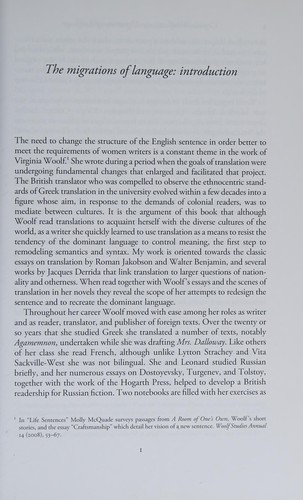
"The need to change the structure of the English sentence in better to meet the requirements of women writers is a constant theme in the work of Virginia Woolf. She wrote during a period when the goals of translation were undergoing fundamental changes that enlarged and facilitated that project. The British translator who was compelled to observe the ethnocentric standards of Greek translation in the university evolved within a few decades into a figure whose aim, in response to the demands of colonial readers, was to mediate between cultures. It is the argument of this book that although Woolf read translations to acquaint herself with the diverse cultures of the world, as a writer she quickly learned to use translation as a means to resist the tendency of the dominant language to control meaning, the first step to remodeling semantics and syntax"--
Menrva's Summary
THE THESIS
This book investigates how Virginia Woolf's engagement with foreign languages and literatures shaped her distinctive prose style and her critique of dominant linguistic structures. Emily Dalgarno argues that Woolf's interest in Greek, French, Russian, and Italian literatures, alongside her work as a translator, profoundly influenced her writing. The study explores how Woolf utilized translation as a strategy to resist the controlling tendencies of the English language, ultimately aiming to remodel semantics and syntax to better accommodate women writers and diverse cultures. It examines specific works like Three Guineas, Orlando, The Waves, and The Years to demonstrate Woolf's evolving approach to language and cultural mediation.
THE SCOPE MAP
- Analysis of Virginia Woolf's engagement with Greek, French, Russian, and Italian literatures.
- Exploration of Woolf's role as a translator and her engagement with contemporary translation standards.
- Examination of how Woolf used foreign languages and translation to critique European politics and societal norms, as seen in Three Guineas.
- Discussion of Woolf's strategies in Orlando to circumvent censorship through untranslatable words.
- Investigation of Woolf's foresight in The Waves and The Years regarding postcolonial societies and cross-border translation.
- Argument that Woolf employed translation to resist the dominant language's control over meaning.
- Focus on Woolf's efforts to remodel English semantics and syntax for women writers.
- A new reading of Woolf's prose through the lens of her multilingualism and translation practices.
THE AUTHORITY PERSPECTIVE
This scholarly work is positioned as the first in-depth study to explore Virginia Woolf's relationship with European languages and literatures. The book's premise suggests it will offer a rewarding new perspective for reading Woolf's prose by focusing on her multilingualism and translation practices. The author's argument centers on Woolf's deliberate use of translation to challenge linguistic dominance and reshape literary expression. It is likely to appeal to academics and students of modernist literature, linguistics, and translation studies.
Page Count:
215
Publication Date:
2012-01-01
ISBN-10:
1107010187
ISBN-13:
9781107010185
Non-Fiction
Philosophy
Literary Fiction
European
Modernism
Literary Criticism
Linguistics
Community Tags
Other Editions(3)


Similar Books