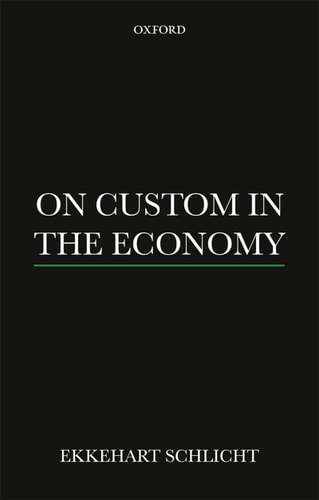
On Custom in the Economy
0
0
As an Amazon Associate and affiliate partner, Menrva Books earns from qualifying purchases. Learn more
Author Description
The aim of this book is to re-establish custom in economics. Current economic theorizing largely neglects the forces of custom that underpin market exchange. Economic sociologists have stressed this repeatedly by referring to the 'embeddedness' of all kinds of economic processes. However, while it is true that market transactions hinge critically on elements of custom, economic processes shape shape custom in turn. This other causal direction needs more attention than it has hitherto received. The way modern institutional economics has developed points to the same deficiency. Institutional economics initially tried to analyse economic institutions as arising from market processes and competition while avoiding reference to all elements of custom, but it became increasingly clear that the answers so obtained were critically dependent on tacit assumptions about the customary infrastructure. One aim of the book is to provide the necessary link between customary elements and market processes.A current strand of thought, notably originating with game theory, has tried to understand the emergence of customs by interpreting them as routines that have been adopted because they were competitively successful. This approach takes customs essentially as conventions that solve coordination problems. It is driven by the economic paradigm that interprets behaviour as fully reducible to the interplay of (given) preferences and constraints while neglecting the direct motivational impact of custom. A second aim of the book is thus to systematically harmonize the motivational significance of custom with institutional theorizing in a systematic way. The re-establishment of custom in economics will provide foundations for institutional thinking and will help in reducing the arbitrariness of current thought.
Menrva's Summary
THE THESIS
This book investigates the neglected role of custom in economic theory and its reciprocal relationship with market processes. Ekkehart Schlicht, an expert in institutional economics, argues that modern economic models suffer from a deficiency by failing to account for the customary infrastructure that supports market exchange. By synthesizing institutional theorizing with the motivational significance of custom, the author seeks to provide a more robust foundation for understanding economic behavior beyond simple preference-constraint models.
THE SCOPE MAP
What You Will Find
- Analysis of the embeddedness of economic processes within social customs
- Critique of game-theoretic approaches that reduce custom to mere coordination routines
- Theoretical framework linking customary elements to market competition
- Systematic integration of motivational psychology with institutional economic analysis
THE AUTHORITY PERSPECTIVE
Scholars in institutional economics recognize this work as a significant attempt to bridge the gap between sociological insights and formal economic modeling. Readers frequently note the technical density of the prose, which requires a strong background in economic theory to fully grasp the author's arguments.
Page Count:
344
Publication Date:
2018-08-28
Publisher:
Oxford University Press
ISBN-10:
0198823460
ISBN-13:
9780198823469
Economics
Game theory
Social Theory
Community Tags
Other Editions(3)
Similar Books














Reader Comments
Share Your Thoughts
No comments yet. Be the first to share your thoughts!