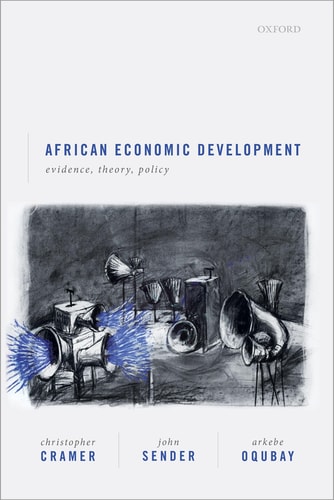
African Economic Development: Evidence, Theory, and Policy
0
0
As an Amazon Associate and affiliate partner, Menrva Books earns from qualifying purchases. Learn more
Author Description
This is an open access title available under the terms of a CC BY-NC-ND 4.0 International licence. It is free to read at Oxford Scholarship Online and offered as a free PDF download from OUP and selected open access locations.Unevenness and inequalities form a central fact of African economic experiences. This book challenges conventional wisdoms about economic performance and possible policies for economic development in African countries, using the striking variation in economic performance as a starting point.African Economic Development: Evidence, Theory, and Policy highlights not only difference between countries, but also variation within countries. It focuses on issues relating to gender, class, and ethnic identity, such as neo-natal mortality, school dropout, and horticultural and agribusiness exports. Variations in these areas point to opportunities for changing perfomance, reducing reducing inequalities, learning from other policy experiences, and escaping the ties of structure and the legacies of a colonial past.African Economic Development rejects teleological illusions and Eurocentric prejudice, criticizing a range of orthodox and heterodox economists for their cavalier attitude to evidence. Instead, it shows that seeing the contradictions of capitalism for what they are - fundamental and enduring - may help policy officials protect themselves against the misleading idea that development can be expected to be a smooth, linear process, or that it would be if certain impediments were removed.Drawing on decades of research and policy experience, this book combines careful use of available evidence from a range of African countries with economic insights to make the policy case for specific types of public sector investment.
Menrva's Summary
THE THESIS
This book investigates the structural causes of economic inequality in Africa, challenging conventional development theories that suggest a linear path to prosperity. The authors, Arkebe Oqubay, Christopher Cramer, and John Sender, leverage decades of combined research and policy experience to critique both orthodox and heterodox economic models. By analyzing the inherent contradictions of capitalism within the African context, they argue that development is a complex, non-linear process that requires targeted public sector investment rather than reliance on simplistic market-based solutions.
THE SCOPE MAP
What You Will Find
- Comparative analysis of economic performance across diverse African nations.
- Examination of socio-economic variables including gender, class, and ethnic identity.
- Empirical data on specific indicators such as neo-natal mortality and school dropout rates.
- Policy frameworks for agribusiness and horticultural export development.
THE AUTHORITY PERSPECTIVE
Experts recognize this work as a rigorous, evidence-based critique of standard development economics that avoids Eurocentric biases. Readers frequently note the academic density of the prose, which makes it a foundational text for scholars and policy practitioners interested in the complexities of African economic growth.
Page Count:
336
Publication Date:
2020-08-11
Publisher:
Oxford University Press
ISBN-10:
0198832338
ISBN-13:
9780198832331
Economics
Economic History
Public Policy
Community Tags
Other Editions(2)
Similar Books







Reader Comments
Share Your Thoughts
No comments yet. Be the first to share your thoughts!