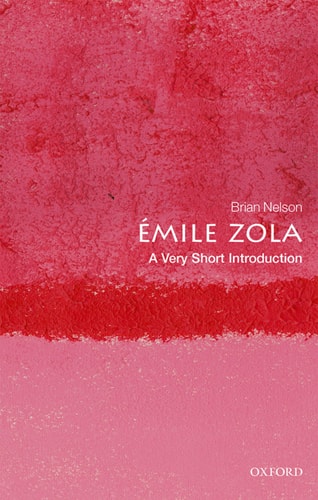
Émile Zola: A Very Short Introduction
0
0
As an Amazon Associate and affiliate partner, Menrva Books earns from qualifying purchases. Learn more
Author Description
Émile Zola was the leader of the literary movement known as 'naturalism' and is one of the great figures of the novel. In his monumental Les Rougon-Macquart (1871-93), he explored the social and cultural landscape of the late nineteenth century in ways that scandalized bourgeois society. Zola opened the novel up to a new realm of subjects, including the realities of working-class life, class relations, and questions of gender and sexuality, and his writing embodied a new freedom of expression, with his bold, outspoken voice often inviting controversy.In this Very Short Introduction, Brian Nelson examines Zola's major themes and narrative art. He illuminates the social and political contexts of Zola's work, and provides readings of five individual novels (The Belly of Paris, L'Assommoir, The Ladies' Paradise, Germinal, and Earth). Zola's naturalist theories, which attempted to align literature with science, helped to generate the stereotypical notion that his fiction was somehow nonfictional. Nelson, however, reveals how the most distinctive elements of Zola's writing go far beyond his theoretical naturalism, giving his novels their unique force. Throughout, he sets Zola's work in context, considering his relations with contemporary painters, his role in the Dreyfus Affair, and his eventual murder.ABOUT THE SERIES: The Very Short Introductions series from Oxford University Press contains hundreds of titles in almost every subject area. These pocket-sized books are the perfect way to get ahead in a new subject quickly. Our expert authors combine facts, analysis, perspective, new ideas, and enthusiasm to make interesting and challenging topics highly readable.
Menrva's Summary
THE THESIS
How did Émile Zola’s commitment to naturalism and his engagement with the social realities of the nineteenth century redefine the scope and function of the modern novel? Brian C. Nelson, an expert in French literature, examines Zola’s career by situating his literary output within the volatile political and cultural climate of his era. The text argues that while Zola’s theoretical framework sought to align fiction with scientific observation, his true significance lies in the artistic force and thematic complexity that transcended his own rigid definitions of naturalism.
THE SCOPE MAP
What You Will Find
- Analysis of the Les Rougon-Macquart cycle and its impact on bourgeois social norms.
- Detailed readings of five key novels: The Belly of Paris, L'Assommoir, The Ladies' Paradise, Germinal, and Earth.
- Historical context regarding Zola’s involvement in the Dreyfus Affair and his relationships with contemporary painters.
- An evaluation of the tension between Zola’s scientific theories of literature and his actual narrative practice.
THE AUTHORITY PERSPECTIVE
This volume is widely regarded as an accessible entry point for students and general readers seeking a concise overview of Zola’s literary contributions. Experts note that Nelson successfully balances biographical detail with critical analysis, providing a clear framework for understanding the complexities of the naturalist movement.
Page Count:
160
Publication Date:
2020-10-01
Publisher:
Oxford University Press
ISBN-10:
0198837569
ISBN-13:
9780198837565
Biography
History
French literature
Literary Criticism
Naturalism
Community Tags
Other Editions(3)
Similar Books




Reader Comments
Share Your Thoughts
No comments yet. Be the first to share your thoughts!