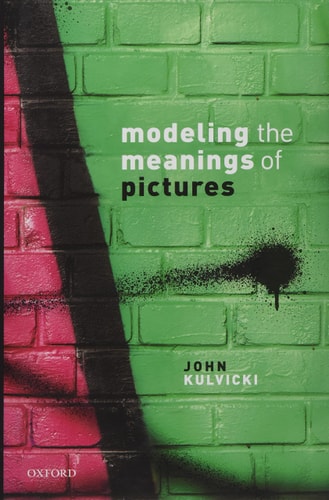
Modeling the Meanings of Pictures
0
0
As an Amazon Associate and affiliate partner, Menrva Books earns from qualifying purchases. Learn more
Author Description
John Kulvicki offers an account of the many ways in which pictures can be meaningful which is inspired by the philosophy of language. Pictures are important parts of communicative acts, along with language, gesture, facial expressions, and props. They express wide ranges of thoughts, make assertions, offer warnings, instructions, and commands. Pictures are also representations. They have meanings, which help explain the range of communicative uses to which they can be put. Modelling the meanings of pictures is accounting for the ways in which pictures manage to be meaningful, with an eye toward how those meanings let us use them as we do.By framing pictures with the philosophy of language, we acquire new perspectives on the many things we can do with them. Sometimes, pictures are used as descriptions--he looks like this!--while sometimes they are used more like singular terms--find him!, while showing a mug shot. Most picture-making cultures also have iconographies, but this is usually put to one side in discussions of pictures, if it is mentioned at all. Likewise, some uses of pictures, especially in advertising, are metaphorical, and very little has been said about metaphor in pictures. Pictures are also related in important ways to other kinds of representations like maps, and this book provides a new way of understanding what makes them alike and different. By showing that pictures are very different from languages, this book also shows that the tools developed with language in mind are not actually specific to linguistic phenomena.
Menrva's Summary
THE THESIS
How do pictures function as meaningful communicative tools, and can the analytical frameworks of the philosophy of language be adapted to explain their representational power? John V. Kulvicki, a scholar in the philosophy of art and mind, investigates the mechanisms behind pictorial meaning by comparing them to linguistic structures. He argues that while pictures are distinct from language, the tools used to analyze linguistic phenomena can be effectively repurposed to understand how images convey assertions, commands, and descriptions. By examining the intersection of representation and communication, the author provides a systematic account of how visual media function within human interaction.
THE SCOPE MAP
What You Will Find
- A comparative analysis between pictorial representation and linguistic structures.
- An exploration of diverse pictorial functions, including descriptions, singular terms, and metaphorical usage.
- A critical examination of iconographies and their role in picture-making cultures.
- A formal distinction between pictures and other representational systems such as maps.
THE AUTHORITY PERSPECTIVE
Experts in aesthetics and philosophy of language recognize this work as a rigorous attempt to bridge the gap between visual studies and analytic philosophy. Readers frequently note the academic density of the prose, which is intended for those already familiar with philosophical discourse regarding representation and semiotics.
Page Count:
176
Publication Date:
2020-11-04
Publisher:
Oxford University Press
ISBN-10:
0198847475
ISBN-13:
9780198847472
Philosophy
Aesthetics
Semiotics
Art Theory
Communication Studies
Community Tags
Similar Books