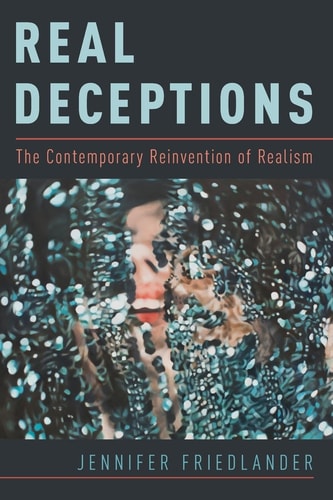
Real Deceptions: The Contemporary Reinvention of Realism
0
0
As an Amazon Associate and affiliate partner, Menrva Books earns from qualifying purchases. Learn more
Author Description
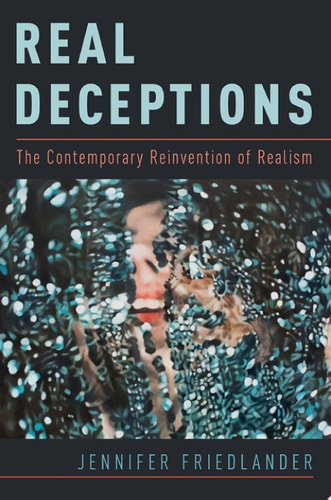
Real Deceptions develops a new theory of realism through close consideration of myriad contemporary art, media, and cultural practices. Rather than focusing on transgressing deceptions which distort reality, the book argues that reality lies within the deceptions themselves. That is to say, realism's political potential emerges not by revealing deception but precisely by staging deceptions--particularly deceptions that imperil the very categories of true and false. In lieu of perceiving deception as an obstacle to truth, it shows how deception functions as the truth's necessary conduit. Categories invoked in realist works, such as trompe l'oeil, illusion, hypervirtuality, and simulation help to establish how realism can be seen as moving from the creation of mere epistemological uncertainty to radical ontologically-based indeterminacy. The book cultivates this schema by considering productive connections between insights from Jacques Lacan and Jacques Rancière. Real Deceptions not only applies these theoretical frameworks to art and media examples, but also engages in the reverse move of using the "cases" to further the theories. This dual approach points to the ways in which efforts to produce realist representations often give rise to the destabilizing Real.
Menrva's Summary
THE THESIS
This book investigates how contemporary realism functions not as a mirror of truth, but as a strategic deployment of deception that challenges the binary of true and false. Jennifer Friedlander, a scholar of critical theory and visual culture, synthesizes the psychoanalytic insights of Jacques Lacan with the political philosophy of Jacques Rancière. By examining various art and media practices, she argues that realism gains its political potency when it embraces ontological indeterminacy rather than attempting to resolve epistemological uncertainty.
THE SCOPE MAP
What You Will Find
- Analysis of trompe l'oeil, hypervirtuality, and simulation as realist techniques.
- A theoretical framework bridging Lacanian psychoanalysis and Rancièrean aesthetics.
- Case studies of contemporary art and media that destabilize the category of the Real.
Scope Limits
- The text does not provide a historical survey of traditional realism in painting or literature.
- It does not offer a practical guide for artists on how to create realist works.
THE AUTHORITY PERSPECTIVE
Scholars and critics recognize this work as a sophisticated contribution to contemporary aesthetic theory that successfully bridges the gap between abstract philosophy and visual practice. Readers frequently note the academic density of the prose, which requires a foundational familiarity with Lacanian and Rancièrean concepts to fully grasp the author's arguments.
Page Count:
168
Publication Date:
2017-01-01
Publisher:
Oxford University Press
ISBN-10:
0190676159
ISBN-13:
9780190676155
Philosophy
Art Theory
Critical Theory
Professional Career & Trade
Aesthetics
Media Studies
Graphic ArtsCommunicationsDesign