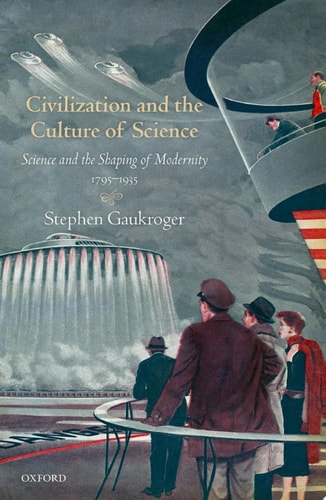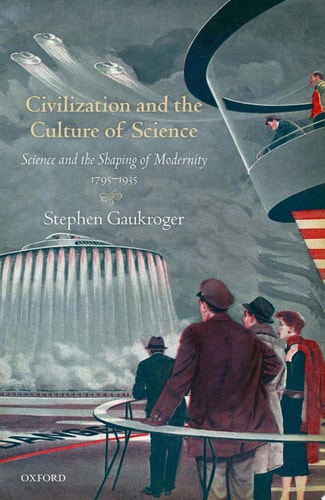
Civilization and the Culture of Science: Science and the Shaping of Modernity, 1795-1935
0
0
As an Amazon Associate and affiliate partner, Menrva Books earns from qualifying purchases. Learn more
Author Description
How did science come to have such a central place in Western culture? How did cognitive values--and subsequently moral, political, and social ones--come to be modelled around scientific values? In Civilization and the Culture of Science, Stephen Gaukroger explores how these values were shaped and how they began, in turn, to shape those of society. The core nineteenth- and twentieth-century development is that in which science comes to take centre stage in determining ideas of civilization, displacing Christianity in this role. Christianity had provided a unifying thread in the study of the world, however, and science had to match this, which it did through the project of the unity of the sciences. The standing of science came to rest or fall on this question, which the book sets out to show in detail is essentially ideological, not something that arose from developments within the sciences, which remained pluralistic and modular. A crucial ingredient in this process was a fundamental rethinking of the relations between science and ethics, economics, philosophy, and engineering. In his engaging description of this transition to a scientific modernity, Gaukroger examines five of the issues which underpinned this shift in detail: changes in the understanding of civilization; the push to unify the sciences; the rise of the idea of the limits of scientific understanding; the concepts of 'applied' and 'popular' science; and the way in which the public was shaped in a scientific image.
Menrva's Summary
THE THESIS
This work investigates how science ascended to a central, foundational position in Western culture, effectively replacing Christianity as the primary framework for defining civilization between 1795 and 1935. Stephen Gaukroger, a distinguished historian of science and philosophy, utilizes a broad historical analysis to argue that the perceived unity of the sciences was an ideological construct rather than an organic development within scientific practice. He examines how scientific values were systematically integrated into the moral, political, and social fabric of modernity, fundamentally altering the relationship between knowledge and societal structure.
THE SCOPE MAP
What You Will Find
- Historical analysis of the transition from religious to scientific frameworks of civilization.
- Examination of the ideological project to unify disparate scientific disciplines.
- Exploration of the shifting boundaries between science, ethics, economics, and engineering.
- Case studies on the emergence of 'applied' and 'popular' science as cultural phenomena.
THE AUTHORITY PERSPECTIVE
Scholars and historians of science frequently cite this text as a rigorous examination of the intellectual shifts that defined the modern era. Readers often note the academic density of the prose, which provides a comprehensive look at the intersection of scientific development and cultural ideology.
Page Count:
544
Publication Date:
2020-05-03
Publisher:
Oxford University Press
ISBN-10:
0198849079
ISBN-13:
9780198849070
Philosophy
History
Science
Sociology
Intellectual History
Modernity