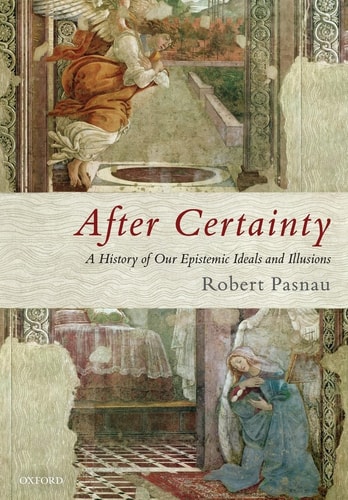
After Certainty: A History of Our Epistemic Ideals and Illusions
Author Description
No part of philosophy is as disconnected from its history as is epistemology. After Certainty offers a reconstruction of that history, understood as a series of changing expectations about the cognitive ideal that beings such as us might hope to achieve in a world such as this. The story begins with Aristotle and then looks at how his epistemic program was developed through later antiquity and into the Middle Ages, before being dramatically reformulated in the seventeenth century. In watching these debates unfold over the centuries, one sees why epistemology has traditionally been embedded within a much larger sphere of concerns about human nature and the reality of the world we live in. It ultimately becomes clear why epistemology today has become a much narrower and specialized field, concerned with the conditions under which it is true to say, that someone knows something.Based on a series of lectures given at Oxford University, Robert Pasnau's book ranges widely over the history of philosophy, and examines in some detail the rise of science as an autonomous discipline. Ultimately Pasnau argues that we may have no good reasons to suppose ourselves capable of achieving even the most minimal standards for knowledge, and the final chapter concludes with a discussion of faith and hope.
Menrva's Summary
THE THESIS
This book investigates the historical evolution of epistemic ideals to explain why contemporary epistemology has narrowed its focus from broad human inquiry to the technical conditions of knowledge. Robert Pasnau, a professor of philosophy, utilizes his extensive research into the history of ideas to reconstruct how cognitive expectations have shifted from antiquity through the Middle Ages and into the modern scientific era. By tracing these intellectual transitions, he argues that our current standards for knowledge may be unattainable, ultimately suggesting that faith and hope remain necessary components of the human condition.
THE SCOPE MAP
What You Will Find
- A historical survey of epistemic programs from Aristotle through the seventeenth century.
- An analysis of the transition of science from a branch of philosophy to an autonomous discipline.
- A critical examination of the shift in philosophical focus regarding human cognitive capacity.
- A concluding synthesis on the role of faith and hope in the face of epistemic uncertainty.
THE AUTHORITY PERSPECTIVE
Experts recognize this work as a significant contribution to the history of philosophy that challenges the insular nature of modern epistemology. Readers frequently note the academic density of the prose, which requires a foundational understanding of philosophical history to fully appreciate the author's arguments.
Page Count:
392
Publication Date:
2020-03-12
Publisher:
Oxford University Press
ISBN-10:
0198852185
ISBN-13:
9780198852186
Politics
Non-Fiction
Philosophy
New Used & Rental Textbooks
Epistemology
History & Surveys
Knowledge Theory
Community Tags
Similar Books