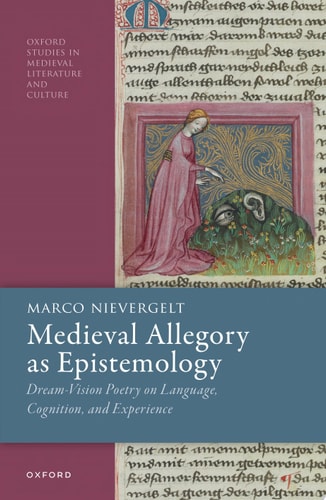
Medieval Allegory as Epistemology: Dream-Vision Poetry on Language, Cognition, and Experience
0
0
As an Amazon Associate and affiliate partner, Menrva Books earns from qualifying purchases. Learn more
Author Description
In Medieval Allegory as Epistemology, Marco Nievergelt argues that late medieval dream-poetry was able to use the tools of allegorical fiction to explore a set of complex philosophical questions regarding the nature of human knowledge. The focus is on three of the most widely read and influential poems of the later Middle Ages: Jean de Meun's Roman de la Rose; the Pélerinages trilogy of Guillaume de Deguileville; and William Langland's vision of Piers Plowman in its various versions. All three poets grapple with a collection of shared, closely related epistemological problems that emerged in Western Europe during the thirteenth century, in the wake of the reception of the complete body of Aristotle's works on logic and the natural sciences. This study therefore not only examines the intertextual and literary-historical relations linking the work of the three poets, but takes their shared interest in cognition and epistemology as a starting point to assess their wider cultural and intellectual significance in the context of broader developments in late medieval philosophy of mind, knowledge, and language. Vernacular literature more broadly played an extremely important role in lending an enlarged cultural resonance to philosophical ideas developed by scholastic thinkers, but it is also shown that allegorical narrative could prompt philosophical speculation on its own terms, deliberately interrogating the dominance and authority of scholastic discourses and institutions by using first-person fictional narrative as a tool for intellectual speculation.
Menrva's Summary
THE THESIS
How did late medieval dream-vision poetry function as a vehicle for exploring complex epistemological questions regarding human knowledge and cognition? Marco Nievergelt, a scholar of medieval literature, utilizes a comparative analysis of three seminal works to argue that allegorical fiction served as a distinct site for philosophical inquiry. By examining the intersection of vernacular literature and scholastic philosophy, the author demonstrates how these poets interrogated the nature of experience and the limits of language in the wake of the Aristotelian reception in Western Europe.
THE SCOPE MAP
What You Will Find
- Comparative analysis of Jean de Meun's Roman de la Rose, Guillaume de Deguileville's Pélerinages trilogy, and William Langland's Piers Plowman.
- Examination of the influence of thirteenth-century Aristotelian logic and natural science on vernacular poetry.
- Discussion of the role of first-person fictional narrative as a tool for intellectual speculation.
Scope Limits
- The study focuses primarily on the specific epistemological concerns of these three authors rather than a comprehensive survey of all medieval dream-vision poetry.
- It does not provide a general history of medieval philosophy, but rather explores the specific interaction between literary form and philosophical discourse.
THE AUTHORITY PERSPECTIVE
Scholars recognize this text as a significant contribution to the understanding of how vernacular literature engaged with scholastic thought. Readers frequently note the academic density of the prose, which is intended for specialists in medieval literature and the history of philosophy.
Page Count:
576
Publication Date:
2023-07-13
Publisher:
Oxford University Press
ISBN-10:
0192849212
ISBN-13:
9780192849212
Poetry
Philosophy
Politics
History & Surveys
Literary Criticism
Medieval Thought
Academic
Epistemology
New Used & Rental Textbooks
Community Tags
Similar Books