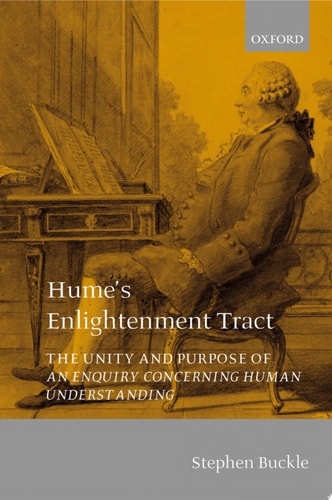
Hume's Enlightenment Tract: The Unity and Purpose of An Enquiry concerning Human Understanding
0
0
As an Amazon Associate and affiliate partner, Menrva Books earns from qualifying purchases. Learn more
Author Description
Hume's Enlightenment Tract is the first full book-length study for forty years of David Hume's Enquiry concerning Human Understanding. The Enquiry has, contrary to its author's expressed wishes, long lived in the shadow of its predecessor, A Treatise of Human Nature. Stephen Buckle presents the Enquiry in a fresh light, and aims to raise it to its rightful position in Hume's work and in the history of philosophy. He argues that the Enquiry is not, as so often assumed, a mere collection of watered-down extracts from the earlier work. It is, rather, a coherent work with a unified argument; and, when this argument is grasped as a whole, the Enquiry shows itself to be the best introduction to the lineaments of its author's general philosophy. Buckle offers a careful guide through the argument and structure of the work. He shows how the central sections of the Enquiry offer a critique of the dogmatic empiricisms of the ancient world (Stoicism, Epicureanism, and Aristotelianism), and set in place an alternative conception of human powers based on the sceptical principles of habit and probability. These principles are then put to work, to rule out philosophy's metaphysical ambitions and their consequences: religious systems and their attendant conception of human beings as semi-divine rational animals. Hume's scepticism, experimentalism, and naturalism are thus shown to be different aspects of the one unified philosophy - a sceptical version of the Enlightenment vision.
Menrva's Summary
THE THESIS
This book investigates the structural and philosophical unity of David Hume's 'An Enquiry concerning Human Understanding' to challenge the long-standing academic view that it is merely a derivative summary of his earlier 'Treatise of Human Nature'. Stephen Buckle, a scholar of Enlightenment philosophy, utilizes a close textual analysis of the 'Enquiry' to demonstrate that it functions as a coherent, independent work. He argues that the text serves as a foundational expression of Hume's mature philosophy, integrating scepticism, naturalism, and experimentalism into a unified vision of human understanding.
THE SCOPE MAP
What You Will Find
- A detailed structural analysis of the 'Enquiry concerning Human Understanding'
- A critique of ancient dogmatic empiricisms including Stoicism, Epicureanism, and Aristotelianism
- An examination of the roles of habit and probability in Hume's epistemology
- A historical contextualization of Hume's work within the broader Enlightenment movement
Scope Limits
- The book does not provide a comprehensive biography of David Hume
- It does not offer an exhaustive comparison of every section of the 'Treatise' against the 'Enquiry'
THE AUTHORITY PERSPECTIVE
Scholars and students of philosophy recognize this work as a significant intervention in Humean studies, particularly for its effort to elevate the 'Enquiry' as a primary text. Readers frequently note the academic density of the prose, which is intended for those already familiar with the core tenets of 18th-century empiricism.
Page Count:
368
Publication Date:
2004-01-01
Publisher:
Oxford University Press, USA
ISBN-10:
0191544051
ISBN-13:
9780191544057
Philosophy
Knowledge Theory
Philosophy history
History & Surveys
Enlightenment
David Hume
Epistemology
Community Tags
Other Editions(2)
Similar Books