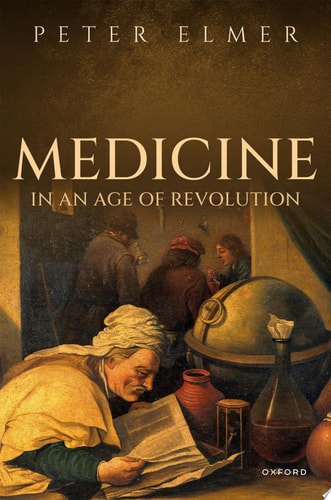
Medicine in an Age of Revolution
0
0
As an Amazon Associate and affiliate partner, Menrva Books earns from qualifying purchases. Learn more
Author Description
This is an open access title available under the terms of a CC BY-NC-ND 4.0 International licence. It is free to read on the Oxford Academic platform and offered as a free PDF download from OUP and selected open access locations.Medicine in an Age of Revolution is the first major attempt since the 1970s to challenge the idea that the essential engine of medical (and scientific) change in seventeenth-century Britain was puritanism. While Peter Elmer seeks to reaffirm the crucial role of the period of the civil wars and their aftermath in providing the most congenial context for a re-evaluation of traditional attitudes to medicine, he rejects the idea that such initiatives were the special preserve of a small religious elite (puritans), claiming instead that enthusiasm for change can be found across the religious spectrum. At the same time, Elmer seeks to show that medical practitioners were increasingly drawn into contemporary religious and political debates in a way that led to a fundamental politicization of the 'profession'. By the end of the seventeenth century, it was commonplace to see doctors, apothecaries, and surgeons fully engaged in everyday political and civic life. At the same time, religious and political orientation often became an important factor in the career development of medics, especially in towns and cities, where substantial benefits might accrue to those who found themselves in favour with the ruling elites, be they Whig or Tory. The body politic, a Renaissance commonplace, was now peopled by medical practitioners who often claimed a special authority when it came to diagnosing the ills of late seventeenth century society.
Menrva's Summary
THE THESIS
This book investigates whether the transformation of seventeenth-century British medicine was driven by puritanism or by broader political and religious shifts. Professor Peter Elmer, a specialist in early modern medical history, challenges the long-standing historiographical consensus that puritanism served as the primary catalyst for scientific and medical advancement during this era. By analyzing the intersection of medical practice and the volatile political landscape of the English Civil War and its aftermath, Elmer argues that medical practitioners were active, politicized participants in society rather than isolated figures, demonstrating that professional success was frequently tied to alignment with Whig or Tory power structures.
THE SCOPE MAP
What You Will Find
- Analysis of the seventeenth-century British medical landscape including doctors, apothecaries, and surgeons.
- Examination of the influence of the English Civil War on professional medical development.
- Evidence drawn from historical records of medical career trajectories in urban centers.
- Exploration of the politicization of the medical profession and its role in diagnosing societal ills.
THE AUTHORITY PERSPECTIVE
Historians and scholars of early modern Britain recognize this work as a significant revisionist study that effectively dismantles the puritan-centric narrative of medical history. The text is noted for its rigorous archival approach and its ability to synthesize complex political and medical developments for an academic audience.
Page Count:
480
Publication Date:
2023-01-01
Publisher:
Oxford University Press
ISBN-10:
019885398X
ISBN-13:
9780198853985
History
Medicine history
British History
Great Britain
Science History
Medicine
Political History
Renaissance
Community Tags
Similar Books