Liveness and Recording in the Media
0
0
As an Amazon Associate and affiliate partner, Menrva Books earns from qualifying purchases. Learn more
Author Description
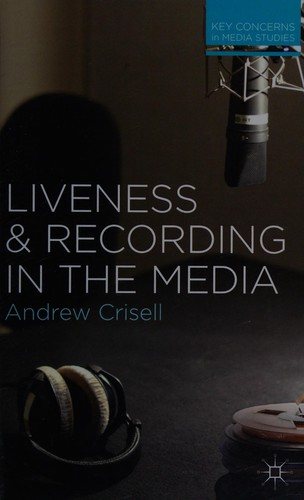
Radio and television are often thought of and valued as live media. The great innovation and distinctive appeal of radio and television was its introduction of liveness into mass communication. So why does so much broadcast output consist of programmes that are pre-recorded and/or time-shifted - consumed by the audience after they have been transmitted? Andrew Crisell considers why, despite the value we place on liveness, we so often consume pre-recorded media. He also provides some unexpected answers about the meaning of 'liveness' and 'recording'; their significance, not only for television and radio but also for popular music, and the complexity of the relationship between liveness and recording. This engaging discussion includes diverse and well-known examples of broadcast output such as the1954 television adaptation of George Orwell's novel 1984, which was performed twice within a single week, Skyping on The Graham Norton Show and the television news coverage of the Bloody Sunday inquiry, and provides an in-depth case study of BBC One. Setting television and radio in the context of other media, it traces the history of liveness and recording, ascribing the rise of the serial to the relationship between the two.
Menrva's Summary
THE THESIS
This book investigates the paradoxical prevalence of pre-recorded media despite the perceived value and appeal of live broadcasting. Andrew Crisell examines the complex relationship between liveness and recording in mass communication, challenging conventional definitions of both terms. The work explores how this dynamic influences not only radio and television but also other media like popular music, drawing on diverse examples from historical broadcasts to contemporary news coverage. It ultimately seeks to understand why audiences so frequently consume media that has been recorded or time-shifted, even when live alternatives are available.
THE SCOPE MAP
- Analysis of the historical development of liveness and recording in broadcast media.
- Exploration of the meaning and significance of 'liveness' and 'recording' in media consumption.
- Case studies including the 1954 television adaptation of '1984', The Graham Norton Show, and Bloody Sunday inquiry news coverage.
- In-depth case study of BBC One's programming strategies.
- Contextualization of television and radio within broader media landscapes.
- Discussion on how the relationship between liveness and recording contributed to the rise of the serial format.
THE AUTHORITY PERSPECTIVE
The book is presented as an engaging discussion that offers unexpected answers regarding the meaning of 'liveness' and 'recording' in media. It aims to provide an in-depth analysis by setting television and radio within the context of other media and tracing historical developments. The author's approach incorporates diverse and well-known examples to illustrate complex relationships between media forms. The work is framed to appeal to those interested in broadcasting history and media studies.
Page Count:
115
Publication Date:
2012-01-01
ISBN-10:
0230282229
ISBN-13:
9780230282223
Non-Fiction
Science
Art
History
Science & Technology
Broadcasting History
Media Studies
Community Tags
Similar Books