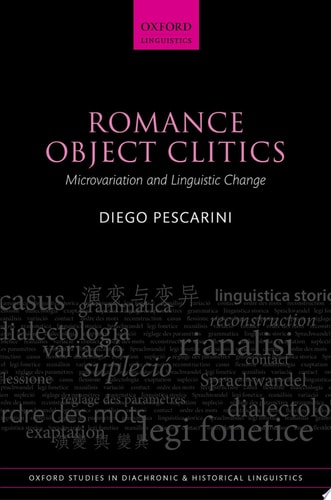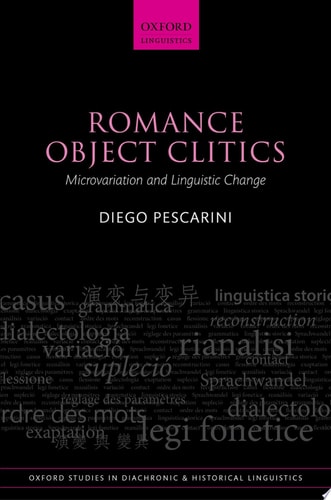
Romance Object Clitics: Microvariation and Linguistic Change
0
0
As an Amazon Associate and affiliate partner, Menrva Books earns from qualifying purchases. Learn more
Author Description
This book offers an empirical and theoretical exploration of the development of object clitic pronouns in the Romance languages, drawing on data from Latin, medieval vernaculars, modern Romance languages, and lesser-known dialects. Diego Pescarini examines phonological, morphological, and especially syntactic aspects of Romance object clitics, using the findings to reconstruct their evolution from Latin to Romance and to model clitic placement in modern Romance languages. On the theoretical side, the volume engages with previous accounts of clitics, particularly in generative theory. It challenges the received idea that cliticization resulted from a form of syntactic deficiency; instead, it proposes that clitics resulted from the feature endowment of discourse features, which initially caused freezing of certain pronominal forms and then - through reanalysis - their successive incorporation to verbal hosts. This approach leads to a revision of earlier analyses of well-known phenomena such as interpolation, climbing, and enclisis/proclisis alternations, and to new approaches to issues including V2 syntax, scrambling, and stylistic fronting, among many others.
Menrva's Summary
THE THESIS
This book investigates the historical evolution and syntactic development of object clitic pronouns across the Romance language family. Diego Pescarini utilizes a vast empirical dataset spanning from Latin through medieval vernaculars to contemporary dialects to challenge traditional generative accounts of cliticization. By proposing that clitics emerged from the feature endowment of discourse features rather than syntactic deficiency, the author provides a new model for understanding pronominal reanalysis and incorporation into verbal hosts.
THE SCOPE MAP
What You Will Find
- Comparative analysis of Latin, medieval vernaculars, and modern Romance dialects
- Theoretical framework addressing clitic placement, interpolation, and climbing
- Examination of phonological, morphological, and syntactic constraints on pronominal forms
- Reassessment of V2 syntax, scrambling, and stylistic fronting phenomena
THE AUTHORITY PERSPECTIVE
Experts in the field recognize this work as a significant contribution to the study of Romance syntax and diachronic change. The text is noted for its high level of academic density and its rigorous application of generative theory to historical data.
Page Count:
352
Publication Date:
2021-05-25
Publisher:
Oxford University Press
ISBN-10:
0198864388
ISBN-13:
9780198864387
Historical linguistics
Linguistics
Morphology
Syntax