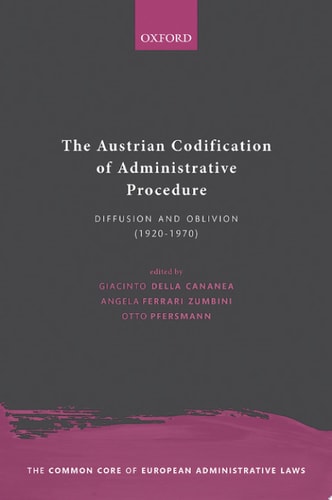
The Austrian Codification of Administrative Procedure: Diffusion and Oblivion (1920-1970)
0
0
As an Amazon Associate and affiliate partner, Menrva Books earns from qualifying purchases. Learn more
Author Description
This book argues that the development of administrative law in Europe owes much to Austria, not only because its Administrative Court was one of the first to define and refine general principles, such as legality, due process and general interest, but also because in 1925 Austria adopted a general law of administrative procedure, which had important consequences for other legal systems.The book follows two themes. The first is the Austrian codification of administrative procedure itself. The second is the spread of Austrian ideas and institutions to some neighbouring countries. From the first point of view, the book points out the various factors that favoured the adoption of administrative procedure legislation and the reception of the model of review. In this respect, the book is enriched by the English translation of the Austrian general act of 1925. From the other viewpoint, the book deviates from the standard accounts whereby the Austrian codification had some influence on its closest neighbours, including Poland, Czechoslovakia and Yugoslavia; first, because it compares their legislative provisions, as well as their durability, notwithstanding drastic political changes, when these countries fell under Soviet rule; second, because it does not limit itself to the concept of 'influence', arguing that there was a 'diffusion' of general administrative procedure legislation; thirdly, because it examines why the major administrative systems of continental Europe, such as France, Germany and Italy, did not adopt administrative procedure legislation. The book thus provides an unprecedented outlook on the emergence of an increasing common core regarding administrative procedure.
Menrva's Summary
THE THESIS
This book investigates the historical development and cross-border diffusion of the 1925 Austrian general law of administrative procedure and its subsequent impact on European legal systems. The authors, a team of legal scholars, utilize a comparative methodology to analyze how Austrian administrative principles were adopted, adapted, or ignored by neighboring nations. By examining the legislative durability of these laws through periods of significant political upheaval, the text argues that the Austrian model served as a critical, yet often overlooked, catalyst for the emergence of a common core of administrative procedure across the continent.
THE SCOPE MAP
What You Will Find
- A detailed analysis of the 1925 Austrian general act of administrative procedure, including its full English translation.
- Comparative studies of legislative frameworks in Poland, Czechoslovakia, and Yugoslavia during and after the transition to Soviet rule.
- An examination of why major continental powers like France, Germany, and Italy resisted the adoption of similar procedural codifications.
- A theoretical framework distinguishing between the concepts of legal 'influence' and the broader 'diffusion' of administrative institutions.
THE AUTHORITY PERSPECTIVE
Legal scholars and historians identify this work as a significant contribution to the study of European administrative law, particularly for its focus on the often-neglected influence of Austrian jurisprudence. Readers frequently note the academic density of the prose, which provides a rigorous, evidence-based analysis suitable for advanced students and practitioners of comparative law.
Page Count:
352
Publication Date:
2023-05-28
Publisher:
Oxford University Press
ISBN-10:
019886762X
ISBN-13:
9780198867623
Law_austria
Law
European History
Administrative Law
Legal History
Community Tags
Similar Books