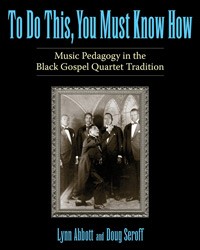
To Do This, You Must Know How
0
0
As an Amazon Associate and affiliate partner, Menrva Books earns from qualifying purchases. Learn more
Author Description
This book is a landmark study tracing the currents of music education that gave form and style to the black gospel quartet tradition. To Do This, You Must Know How traces black vocal music instruction and inspiration from the halls of Fisk University to the mining camps of Birmingham and Bessemer, Alabama, and on to Chicago and New Orleans. In the 1870s, the Original Fisk University Jubilee Singers successfully combined Negro spirituals with formal choral music disciplines and established a permanent bond between spiritual singing and music education. Early in the twentieth century there were countless initiatives in support of black vocal music training conducted on both national and local levels. The surge in black religious quartet singing that occurred in the 1920s owed much to this vocal music education movement. In Bessemer, Alabama, the effect of school music instruction was magnified by the emergence of community-based quartet trainers who translated the spirit and substance of the music education movement for the inhabitants of workingclass neighborhoods. These trainers adapted standard musical precepts, traditional folk practices, and popular music conventions to create something new and vital. Bessemer's musical values directly influenced the early development of gospel quartet singing in Chicago and New Orleans through the authority of emigrant trainers whose efforts bear witness to the effectiveness of "trickle down" black music education. A cappella gospel quartets remained prominent well into the 1950s, but by the end of the century the close harmony aesthetic had fallen out of practice, and the community-based trainers who were its champions had virtually disappeared, foreshadowing the end of this remarkable musical tradition. - Publisher.
Menrva's Summary
THE THESIS
This book investigates the origins and evolution of the black gospel quartet tradition through the lens of music education. Lynn Abbott traces the development of this musical form from its roots in formal institutions like Fisk University to its dissemination in working-class communities in Alabama, Chicago, and New Orleans. The study highlights the crucial role of community-based trainers who adapted standard musical precepts and folk practices to create a new and vital sound. The book concludes by noting the decline of this tradition and its practitioners by the late 20th century.
THE SCOPE MAP
- The historical currents of music education that shaped black gospel quartet singing.
- The influence of Fisk University and the Original Fisk University Jubilee Singers.
- The development of vocal music training initiatives in the early 20th century.
- The role of community-based quartet trainers in Bessemer, Alabama.
- The migration of musical values to Chicago and New Orleans.
- The prominence of a cappella gospel quartets through the 1950s.
- The eventual decline of the close harmony aesthetic and its trainers.
THE AUTHORITY PERSPECTIVE
The book is recognized as a significant contribution to the study of African American music history and education. Its detailed tracing of the gospel quartet tradition from its institutional origins to community-level practice offers a comprehensive view of the genre's development. The work is noted for its exploration of how formal music education intersected with folk practices and popular conventions to create a unique sound. The study's conclusion reflects on the historical arc of this musical form and the disappearance of its key practitioners.
Page Count:
478
Publication Date:
2013-01-01
ISBN-10:
1617036757
ISBN-13:
9781617036750
History
Non-Fiction
Music
Music History
Music Education
Gospel Music
Community Tags
Similar Books