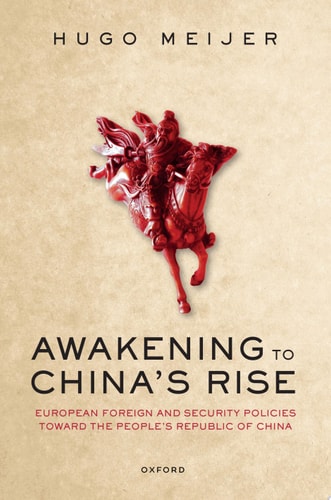
Awakening to China's Rise: European Foreign and Security Policies toward the People's Republic of China
0
0
As an Amazon Associate and affiliate partner, Menrva Books earns from qualifying purchases. Learn more
Author Description
Awakening to China's Rise provides the most comprehensive analysis to date of how Europe's major powers have responded to the re-emergence of China as a great power in world politics since the end of the Cold War. To do so, it puts forward a unique cross-regional comparison of how the major European powers (France, Germany and the United Kingdom) have confronted Chinese assertiveness both in the Asia-Pacific and in Europe. Firstly, it analyses their response to China's increasingly muscular regional posture in the Asia-Pacific through the development of diplomatic and security initiatives with partners in the region. Secondly, it delineates how they have confronted China's inroads into Europe, looking at the measures that they have taken to tackle Chinese investments in, and supply of, technologies in strategic sectors such as critical national infrastructures, dual-use technologies, and in the digital domain, including Huawei's 5G networks. A longstanding assumption in the IR literature has been that European foreign policies toward the People's Republic of China have been driven by a 'naïve' and self-interested focus on the economic opportunities presented by such a vast market, overlooking security considerations. This book challenges such common belief through a detailed examination of the policies of France, Germany and the United Kingdom from 1989 to the present. Its central argument is that, whereas this assessment aptly characterized the first two post-Cold War decades, Beijing's growing assertiveness after 2009 caused the three major European powers to awaken to China's rise. In the 2010s, heightened threat perceptions of China, coupled with increasingly competitive bilateral economic relations with the PRC, have gradually and cumulatively caused the hardening of their policy goals which, in turn, translated into the formulation of new policy instruments to confront such a challenge. To substantiate this argument, the book relies on a large body of previous
Menrva's Summary
THE THESIS
This book investigates how the major European powers—France, Germany, and the United Kingdom—have fundamentally shifted their foreign and security policies in response to the re-emergence of China as a global power since the end of the Cold War. Hugo Meijer, a scholar of international relations, utilizes a cross-regional comparative framework to challenge the long-standing academic assumption that European engagement with China was historically driven solely by economic opportunism. By examining policy shifts from 1989 to the present, the author argues that Beijing's increased assertiveness after 2009 forced a strategic awakening, leading these nations to develop new security instruments to mitigate perceived threats.
THE SCOPE MAP
What You Will Find
- A comparative analysis of foreign policy trajectories in France, Germany, and the United Kingdom.
- Examination of European responses to Chinese influence in the Asia-Pacific region.
- Detailed assessment of defensive measures regarding critical national infrastructure, dual-use technologies, and 5G network security.
- A longitudinal study of policy evolution from the post-Cold War era through the 2010s.
THE AUTHORITY PERSPECTIVE
Experts identify this work as a significant contribution to the study of contemporary European security architecture and its adaptation to a multipolar world. Scholars frequently cite the book for its rigorous empirical approach in dismantling the 'naïve' economic narrative that previously dominated the field of international relations.
Page Count:
336
Publication Date:
2022-11-23
Publisher:
Oxford University Press
ISBN-10:
0198865538
ISBN-13:
9780198865537
International relations
Foreign Policy
Asia history
European History
Geopolitics
Community Tags
Similar Books