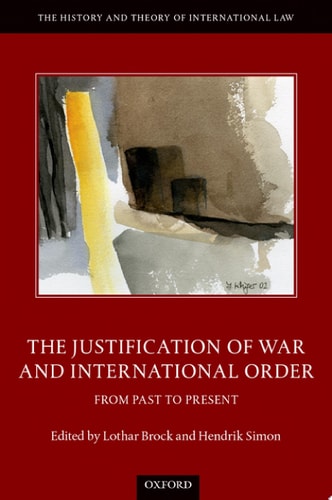
The Justification of War and International Order: From Past to Present
0
0
As an Amazon Associate and affiliate partner, Menrva Books earns from qualifying purchases. Learn more
Author Description
The history of war is also a history of its justification. The contributions to this book argue that the justification of war rarely happens as empty propaganda. While it is directed at mobilizing support and reducing resistance, it is not purely instrumental. Rather, the justification of force is part of an incessant struggle over what is to count as justifiable behaviour in a given historical constellation of power, interests, and norms. This way, the justification of specific wars interacts with international order as a normative frame of reference for dealing with conflict. The justification of war shapes this order, and is being shaped by it.As the justification of specific wars entails a critique of war in general, the use of force in international relations has always been accompanied by political and scholarly discourses on its appropriateness. In much of the pertinent literature the dominating focus is on theoretical or conceptual debates as a mirror of how international normative orders evolve. In contrast, the focus of the present volume is on theory and political practice as sources for the re- and de-construction of the way in which the justification of war and international order interact.With contributions from international law, history, and international relations, and from Western and non-Western perspectives, this book offers a unique collection of papers exploring the continuities and changes in war discourses as they respond to and shape normative orders from early modern times to the present.
Menrva's Summary
THE THESIS
This volume investigates the reciprocal relationship between the justification of war and the evolution of international order from the early modern period to the present day. The authors, including Lothar Brock and Hendrik Simon, utilize a multidisciplinary framework that integrates perspectives from international law, history, and political science. By examining both theoretical discourse and political practice, the text argues that the rhetoric used to legitimize force is not merely propaganda but a critical mechanism that shapes and is simultaneously constrained by international normative structures.
THE SCOPE MAP
What You Will Find
- Historical analysis of war justification from early modern times to the contemporary era
- Interdisciplinary methodology combining international law, history, and international relations
- Comparative study of Western and non-Western perspectives on the use of force
- Theoretical framework for understanding the interaction between normative orders and political practice
THE AUTHORITY PERSPECTIVE
Experts recognize this collection as a significant contribution to the study of international normative orders due to its broad historical and geographic scope. Scholars frequently note the academic density of the prose, making it a valuable resource for researchers and students of political theory and legal history.
Page Count:
560
Publication Date:
2021-04-11
Publisher:
Oxford University Press
ISBN-10:
0198865309
ISBN-13:
9780198865308
History
International Law
War Studies
International relations
Community Tags
Similar Books