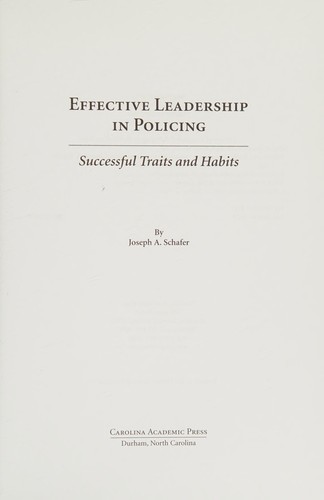
Effective Leadership in Policing
0
0
As an Amazon Associate and affiliate partner, Menrva Books earns from qualifying purchases. Learn more
Author Description
When crisis and scandal emerge in law enforcement organizations, leadership is often identified as a key factor contributing to those failures. Police agencies continue to struggle to adopt and fully implement innovative practices to facilitate long-term reductions in crime and disorder. There is an acute need for better leaders and leadership in policing. Effective Leadership in Policing examines the traits and habits of effective police leaders using survey data collected from over 1,800 mid-career police supervisors attending the prestigious FBI National Academy program in Quantico, VA. The book emphasizes eight traits supervisors identified with effective police leaders, including: honesty and integrity; listening and communication; delegation and empowerment; interpersonal skills; trust and fairness; taking action; innovation and growth; and, leading by example. Attention is also given to the traits and habits of ineffective police leaders, those who are in positions where they should be able to provide a positive influence in their workplace, but fail to do so. The book concludes with a consideration of how more effective leaders might be developed in policing. The book blends narrative data with a review of prior leadership research to provide an understanding of why and how police supervisors link a core group of traits and habits with greater leadership efficacy.
Menrva's Summary
THE THESIS
Effective leadership is crucial for addressing failures and driving innovation within law enforcement agencies. This book investigates the characteristics of successful police leaders by analyzing survey data from over 1,800 mid-career supervisors at the FBI National Academy. It highlights eight key traits identified by these supervisors, such as honesty, integrity, communication, delegation, interpersonal skills, trust, fairness, action-orientation, and a commitment to innovation and growth. The work also contrasts these with the habits of ineffective leaders and concludes by exploring strategies for developing more capable leaders in the policing field.
THE SCOPE MAP
- Analysis of survey data from over 1,800 mid-career police supervisors.
- Identification and emphasis on eight core traits of effective police leaders.
- Detailed examination of traits such as honesty, integrity, listening, communication, delegation, and empowerment.
- Exploration of interpersonal skills, trust, fairness, and the importance of taking action.
- Discussion on innovation, growth, and leading by example in policing.
- Consideration of the traits and habits associated with ineffective police leaders.
- Analysis of how more effective leaders can be developed within policing.
- Blending of narrative data with a review of prior leadership research.
THE AUTHORITY PERSPECTIVE
The book addresses a critical need for improved leadership within law enforcement, a topic frequently cited in relation to organizational failures and the slow adoption of innovative practices. By grounding its analysis in survey data from experienced police supervisors, it offers practical insights into the traits that contribute to leadership efficacy. The work is likely to be of interest to current and aspiring police leaders, as well as academics studying public administration and organizational behavior.
Page Count:
218
Publication Date:
2012-01-01
ISBN-10:
1594608032
ISBN-13:
9781594608032
Business
Non-Fiction
Leadership
Management
Law Enforcement
Community Tags
Similar Books