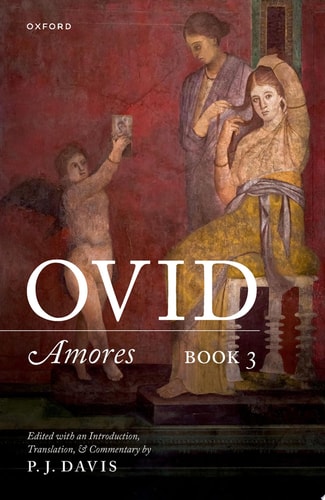
Ovid: Amores Book 3: Edited with an Introduction, Translation, and Commentary
0
0
As an Amazon Associate and affiliate partner, Menrva Books earns from qualifying purchases. Learn more
Author Description
Augustan love elegy represents one of the most important and most distinctive Roman contributions to European and world literature. This volume presents the first detailed commentary in any language on Ovid's Amores Book 3, the last collection of love poems composed in the Augustan age. Aimed at both students and scholars, the commentary has been written to be as accessible to as many readers as possible, with all quotations from ancient Greek and modern languages being translated. It includes an Introduction for the general reader which pays particular attention not only to the book's poetic design and the distinctive features of Ovid's style, but the relationship of the whole three-book collection to earlier love elegy and its handling of political and social questions. It offers an edition of the text of Book 3 based on printed editions together with a translation designed to clarify the surface meaning of the Latin. P. J. Davis's commentary focuses on topics including Ovid's engagement with the works of earlier poets, his use of rhetoric and wit, his employment of verbal and metrical patterns, textual difficulties, and, of course, the elucidation of linguistic problems.Amores Book 3 takes love elegy in new directions giving us, for example, a dream-vision poem, a dutiful husband's account of a religious pilgrimage, and the speech of a pickup artist trying to seduce a girl at the races. Perhaps its most striking feature is its shift away from obsession with a single mistress to reflection on the poet's place in the tradition of Latin love poetry, with poems explicitly devoted to issues raised by Catullus, Tibullus, and Propertius.
Menrva's Summary
THE THESIS
This volume investigates the final book of Ovid's Amores to determine its significance within the broader tradition of Augustan love elegy and its evolution of the genre. Professor P. J. Davis, an expert in classical literature, utilizes a comprehensive analytical framework to examine the text's linguistic, rhetorical, and thematic components. By situating the poems within the context of earlier elegiac works by Catullus, Tibullus, and Propertius, the author argues that Ovid intentionally shifts the focus from singular romantic obsession to a meta-poetic reflection on the poet's role and legacy.
THE SCOPE MAP
What You Will Find
- A complete edition and English translation of Ovid's Amores Book 3.
- Detailed commentary on Ovid's use of rhetoric, wit, and metrical patterns.
- Analysis of the poem's engagement with political and social questions of the Augustan age.
- Examination of specific poetic innovations, including dream-vision narratives and dramatic monologues.
THE AUTHORITY PERSPECTIVE
Scholars and students frequently highlight this volume as a foundational resource for understanding the technical and thematic nuances of Ovid's later elegiac work. The commentary is noted for its accessibility, effectively bridging the gap between specialized academic inquiry and the needs of the general reader.
Page Count:
400
Publication Date:
2024-01-01
Publisher:
Oxford University Press
ISBN-10:
0198871309
ISBN-13:
9780198871309
Poetry
Ancient History
Literary Criticism
Latin
Community Tags
Similar Books