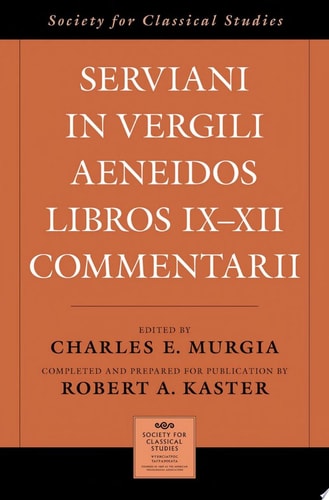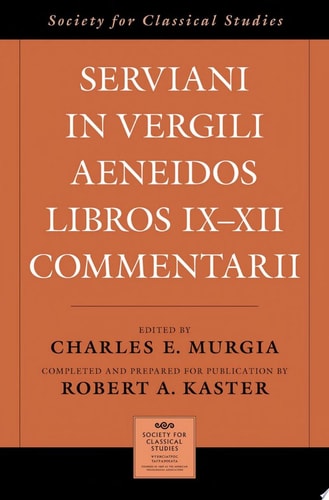
Serviani in Vergili Aeneidos Libros IX-XII Commentarii
0
0
As an Amazon Associate and affiliate partner, Menrva Books earns from qualifying purchases. Learn more
Author Description
The Servian Commentaries On Vergil Are Doubly Distinguished: They Are Among The Very Few Ancient Commentaries On Classical Latin Texts To Survive Essentially Intact; And They Exist In Two Radically Different Forms-the Original Commentary Created By The Grammarian Servius Early In The Fifth Century, Emphasizing Grammar And Syntax, And An Augmented Version Produced In The Seventh Century When A Reader Blended His Servius With Much Other Recherché Ancient Lore. In The 1920s, The Medievalist Edward Kennard Rand Undertook To Produce A Truly Modern Edition That Would Fully Reveal For The First Time The Character Of The Commentaries' Two Versions. All Did Not Go Smoothly, However: A Volume Devoted To Aeneid 1-2 Appeared In 1946, And Another, With The Commentaries On Aeneid 3-5, In 1965; This Edition Of The Commentaries On Aeneid 9-12 Is The First New Contribution To The Series To Appear In More Than Fifty Years. On His Death In 2013, Charles E. Murgia Left Publishable Versions Of The Text, Upper And Lower Critical Apparatuses, And Large Parts Of The Introduction, And He Had Gathered Most Of The Data For A Testimonial Apparatus. Robert A. Kaster Completed The Work On The Testimonia And Introduction (using Some Of Murgia's Other Writings To Supplement The Latter), Added Some Subsidiary Elements, And Prepared The Whole For Publication. Thanks Primarily To Murgia's Work, This Edition Is Superior To Its Predecessors In The Series, And To All Other Editions Of Servius, In Every Respect.
Menrva's Summary
THE THESIS
This volume addresses the challenge of reconstructing the dual-layered textual history of the Servian commentaries on Virgil’s Aeneid. By synthesizing the original fifth-century grammatical notes of Servius with the seventh-century augmented version, the work aims to provide a definitive critical edition that clarifies the evolution of these ancient texts.
THE SCOPE MAP
What You Will Find
- Critical text and apparatus for Aeneid books 9-12
- Comparative analysis of the original Servius and the augmented Servius
- Extensive testimonial apparatus documenting sources and influences
Scope Limits
- This volume is restricted to books 9-12 of the Aeneid and does not cover the entire epic
- The text focuses on philological reconstruction rather than literary interpretation of Virgil’s poetry
THE AUTHORITY PERSPECTIVE
Scholars recognize this edition as a significant advancement in the study of the Servian commentaries, particularly due to the meticulous work left by Charles E. Murgia. It is considered a necessary resource for classicists and philologists working with the textual history of Latin literature.
Page Count:
673
Publication Date:
2018-01-01
Publisher:
Oxford University Press
ISBN-10:
0190849576
ISBN-13:
9780190849573
Philology
Reference
Literary Criticism
Latin
Ancient History