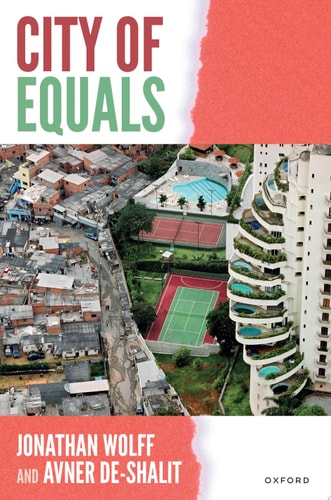
City of Equals
0
0
As an Amazon Associate and affiliate partner, Menrva Books earns from qualifying purchases. Learn more
Author Description
When we think about equality in the city, we are very likely to think first of the wide and growing divide between rich and poor, in material terms. Yet when we think more about a 'city of equals' it becomes apparent that how people feel treated by the city and those around them, and whether they can live according to their values, are much more central. Accordingly, combining their own reflections, a multi-disciplinary literature review, and, distinctively, more than 180 interviews in 10 cities in 6 countries, Wolff and de Shalit have derived an account of a city of equals based on the idea that it should give each of its city-zens a secure sense of place or belonging.Four underlying values structure this account. First, access to the goods and services of the city should not be based purely on the market. Second, each person should be able to live a life they find meaningful. Third, there should be diversity and wide social mixing. Fourth, there should be 'non-deferential inclusion': each person should be able to get access to what they are entitled to without being treated as less worthy than others. They should be able to enjoy their rights without bowing and scraping, waiting longer than others, or going through special bureaucratic hurdles. In sum, in a city of equals each person is proud of their city and has the (justified) feeling that their city is proud of (people like) them.This is an open access title available under the terms of a [CC BY-NC-ND 4.0 International] licence. It is free to read at Oxford Scholarship Online and offered as a free PDF download from OUP and selected open access locations.
Menrva's Summary
THE THESIS
This book investigates the fundamental question of what constitutes a city of equals and how urban environments can foster a genuine sense of belonging and dignity for all residents. Professors Avner de Shalit and Jonathan Wolff utilize a multi-disciplinary approach, combining philosophical reflection with extensive empirical data to argue that equality in a city extends beyond material wealth. They propose a framework centered on four core values: non-market access to services, the ability to lead a meaningful life, social diversity, and non-deferential inclusion. By synthesizing these concepts, the authors provide a normative account of how urban spaces should function to ensure every citizen feels valued by their community.
THE SCOPE MAP
What You Will Find
- A comprehensive analysis of urban equality based on over 180 interviews conducted across 10 cities in 6 countries.
- A theoretical framework defining the four pillars of an equal city: non-market access, meaningful living, social mixing, and non-deferential inclusion.
- A critique of current urban bureaucratic hurdles that undermine the dignity of residents.
- A synthesis of multi-disciplinary literature regarding urban sociology, political philosophy, and public policy.
THE AUTHORITY PERSPECTIVE
Experts and urban scholars recognize this work as a significant contribution to the intersection of political philosophy and urban studies. Readers frequently note the accessibility of the prose despite the academic rigor of the research, making it a foundational text for those interested in social justice and city governance.
Page Count:
224
Publication Date:
2024-01-01
Publisher:
Oxford University Press
ISBN-10:
0198894732
ISBN-13:
9780198894735
Philosophy
Sociology
Public Policy
urban planning
Community Tags
Similar Books