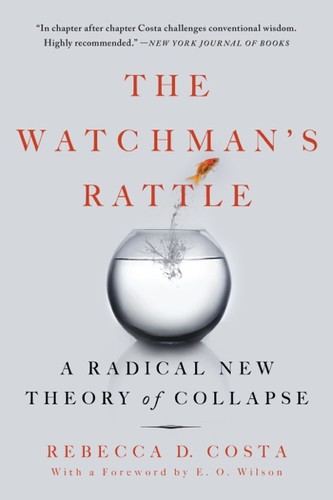
The Watchman's Rattle: A Radical New Theory of Collapse
0
0
As an Amazon Associate and affiliate partner, Menrva Books earns from qualifying purchases. Learn more
Author Description
Passing recession or worldwide collapse? Why are economic, social and political problems leaping ahead faster than governments can patch them up? Business professionals, politicians, housewives, academia, and an ever-lengthening unemployment line are desperate to understand why our problems keep getting bigger. Now comes The Watchman's Rattle: A Radical New Theory of Collapse, a book that connects the dots between crime, oil prices, Wall Street, global warming, nuclear waste and childhood violence. In the tradition of Malcolm Gladwell and Thomas Friedman, scholar and author Rebecca D. Costa reveals the four telltale patterns which paralyze innovative thinking, and with it, a civilization's ability to solve complex problems. Using both historic and modern day examples, The Watchman's Rattle describes what happens when complexity races ahead of the brain's ability to manage it, the underlying reason why experts and governments can no longer fix global crisis and conflict. In The Watchman's Rattle, Costa shows how the same deconstructionist problem solving techniques used to "find lost luggage" are ineffectively being used to address global warming, war, poverty and the worldwide financial crisis. The Watchman's Rattle: A Radical New Theory of Collapse turns a complicated web of public policies and human behaviors into an unstoppable, page-turning, entertaining book.
Menrva's Summary
THE THESIS
The Watchman's Rattle investigates why complex global problems are accelerating beyond humanity's capacity to solve them. The book posits that economic, social, and political issues are outpacing governmental solutions due to a fundamental mismatch between complexity and cognitive ability. Author Rebecca D. Costa identifies four patterns that hinder innovative thinking and explains how this cognitive paralysis affects civilizations. Using historical and contemporary examples, Costa argues that the methods used to address global crises are akin to those used for trivial problems, leading to ineffective solutions for issues like global warming, war, and financial instability.
THE SCOPE MAP
- Analysis of four patterns that paralyze innovative thinking in civilizations.
- Connection of disparate global issues such as crime, oil prices, global warming, and childhood violence.
- Explanation of how complexity outpaces the brain's ability to manage it.
- Critique of deconstructionist problem-solving techniques applied to global crises.
- Historical and modern-day examples illustrating the theory of collapse.
- Discussion on why experts and governments struggle to resolve complex global conflicts.
THE AUTHORITY PERSPECTIVE
The book is presented as a radical new theory of collapse, connecting a wide array of contemporary problems. It aims to explain why current approaches to global crises are failing by identifying underlying patterns in human and societal behavior. The author's approach is described as analytical, drawing parallels between historical and modern events to illustrate her points. The framing suggests a work that seeks to provide a new lens through which to understand and potentially address systemic global challenges.
Page Count:
319
Publication Date:
2010-01-01
ISBN-10:
1593156863
ISBN-13:
9781593156862
Economics
Business
Science
Non-Fiction
Philosophy
Global Issues
Systems Theory
Sociology
Community Tags
Similar Books