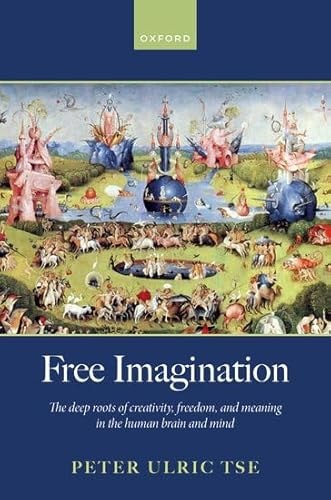
Free Imagination: The Deep Roots of Creativity, Freedom and Meaning in the Human Brain and Mind
0
0
As an Amazon Associate and affiliate partner, Menrva Books earns from qualifying purchases. Learn more
Author Description
The Brain's Capacity To Imagine Is The Fundamental Basis Of Human Free Will. Laws Of Physics Need Not Apply In Our Internal Simulations, So Virtually Anything Is Possible There. And Since Some Of Our Actions Can Follow From That Which We Imagine, Especially From Processes Of Deliberation That Involve Imagining Possible Scenarios And Outcomes, Our Actions Inherit The Freedom Of Our Imaginings. The Creative Power Of The Human Imagination May Have Evolved As A Consequence Of The Demodularization Of Neural Circuitry Associated With Volitional Attentional Operations And Virtual Hand And Body Actions Over Operands Downloadable Into A Mental Workspace Where, Virtually, Anything Could Be Combined With Anything Else. This New Cognitive Architecture Gave Rise To The Danger Of Psychosis. Our Schizotypal Form Of Imagination, Arising From The Promiscuous, Generative And Iterative Combination Of Disencapsulated Operators And Operands In A Mental Workspace, May Have Evolved Only In Humans By Exapting From Existing Motoric And Other Operations Involved In Volitional Hand Dexterity To A Domain Of Premotoric Simulation
Menrva's Summary
THE THESIS
This book investigates the neurological and evolutionary origins of human imagination and its role as the foundational mechanism for free will. Peter Tse, a professor of cognitive neuroscience, utilizes a framework rooted in neural circuitry and cognitive architecture to argue that the brain's ability to simulate scenarios independent of physical laws allows for genuine volitional action. By examining the transition from motoric operations to abstract mental workspaces, the author posits that human creativity and freedom are direct consequences of specific evolutionary changes in neural connectivity.
THE SCOPE MAP
What You Will Find
- Analysis of neural circuitry and the demodularization of brain functions.
- Examination of the relationship between volitional attentional operations and mental simulation.
- Discussion of the evolutionary exaptation of motor dexterity into abstract cognitive domains.
- Exploration of the link between creative cognitive architecture and the emergence of schizotypal traits.
THE AUTHORITY PERSPECTIVE
Experts in cognitive science recognize this work as a dense, technical exploration of the biological basis of consciousness and volition. Readers frequently note the challenging nature of the prose, which requires a foundational understanding of neuroscience to fully grasp the author's arguments regarding neural operators and operands.
Page Count:
240
Publication Date:
2024-01-01
Publisher:
Oxford University Press
ISBN-10:
0198901186
ISBN-13:
9780198901181
Psychology
Evolutionary Biology
Neuroscience
Community Tags
Similar Books