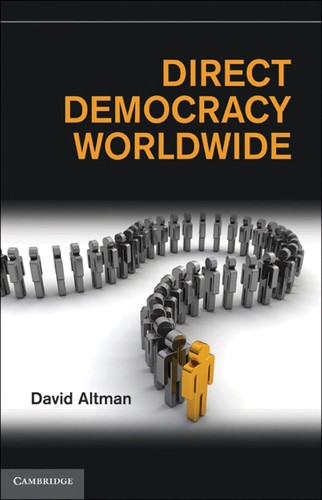
Direct Democracy Worldwide
0
0
As an Amazon Associate and affiliate partner, Menrva Books earns from qualifying purchases. Learn more
Author Description
Challenging the assumption that models of direct democracy and representative democracy are necessarily at odds, this book demonstrates how practices of direct and representative democracy interact under different institutional settings and uncovers the conditions that allow them to coexist in a mutually reinforcing manner. Whereas citizen-initiated mechanisms of direct democracy can spur productive relationships between citizens and political parties, other mechanisms of direct democracy often help leaders bypass other representative institutions, undermining republican checks and balances. The book also demonstrates that the embrace of direct democracy is costly, may generate uncertainties and inconsistencies, and in some cases is easily manipulated. Nonetheless, the promise of direct democracy should not be dismissed. Direct democracy is much more than a simple, pragmatic second choice when representative democracy seems not to be working as expected. Properly designed, it can empower citizens, breaking through some of the institutionalized barriers to accountability that arise in representative systems
Menrva's Summary
THE THESIS
This book challenges the conventional view that direct and representative democracy are inherently conflicting systems. It explores how these two forms of governance can interact and coexist, even in a mutually reinforcing manner, by examining various institutional settings. The author investigates the conditions under which direct democracy can foster positive relationships between citizens and political parties, while also acknowledging instances where it can undermine checks and balances by allowing leaders to bypass representative institutions. The work posits that while direct democracy can be costly and prone to manipulation, well-designed mechanisms can empower citizens and enhance accountability within representative systems.
THE SCOPE MAP
- Analysis of the interaction between direct and representative democracy across different institutional settings.
- Identification of conditions that enable the coexistence of direct and representative democratic practices.
- Examination of how citizen-initiated direct democracy mechanisms can influence citizen-party relationships.
- Discussion of how certain direct democracy mechanisms can bypass representative institutions and affect checks and balances.
- Evaluation of the costs, uncertainties, and potential for manipulation associated with direct democracy.
- Exploration of how properly designed direct democracy can empower citizens and improve accountability.
- Comparative analysis of global practices of direct democracy.
THE AUTHORITY PERSPECTIVE
The book is presented as a scholarly work that challenges established assumptions in political science regarding the relationship between direct and representative democracy. It aims to provide a nuanced understanding of how these systems can interact and potentially complement each other. The author's analysis focuses on institutional settings and the conditions that allow for their coexistence, suggesting a framework for evaluating the effectiveness and potential drawbacks of direct democratic mechanisms. The work is positioned to inform academic discourse on democratic theory and practice.
Page Count:
248
Publication Date:
2011-01-01
ISBN-10:
1107001641
ISBN-13:
9781107001640
Politics
Science
Non-Fiction
Government
Comparative Politics
Democracy
Community Tags
Similar Books