Telling Time
0
0
As an Amazon Associate and affiliate partner, Menrva Books earns from qualifying purchases. Learn more
Author Description
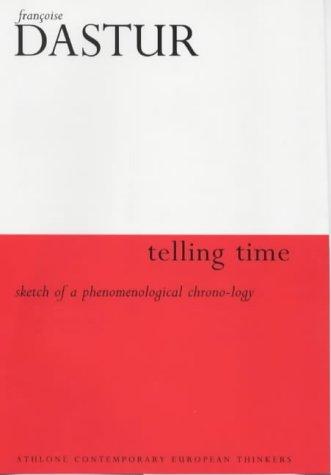
Telling Time takes up Heidegger's idea of a "phenomenological chronology" in an attempt to pose the question of the possibility of a phenomenological language that would be given over to the "temporary of being" and the finitude of existence. The book combines a discussion of approaches to language in the philosophical tradition with readings of Husserl on temporality and the early and late texts of Heidegger's on logic, truth and the nature of language. As well as Heidegger's "deconstruction" of logic and metaphysics Daster's work is also informed by Derrida's deconstruction of the metaphysics of presence and Nietzchean genealogy. Appealing as much to Humboldt's philosophy of language as to Holderlin's poetic thought, the book illuminates the eminently dialectical structure of speech and its essential connection with mortality.--BOOK JACKET.
Menrva's Summary
THE THESIS
The book investigates the possibility of a phenomenological language capable of expressing the temporal nature of being and the finitude of existence. Dastur draws upon Heidegger's concept of
THE SCOPE MAP
- A discussion of approaches to language within the philosophical tradition.
- Readings of Husserl on temporality.
- Analysis of early and late Heidegger texts on logic, truth, and language.
- Exploration of Derrida's deconstruction of the metaphysics of presence.
- Examination of Nietzschean genealogy.
- Consideration of Humboldt's philosophy of language.
- Insights into Hölderlin's poetic thought.
THE AUTHORITY PERSPECTIVE
This work is likely to appeal to scholars and advanced students of continental philosophy, particularly those interested in phenomenology, existentialism, and the philosophy of language. The book's dense theoretical framework, engaging with complex thinkers like Heidegger and Derrida, suggests a rigorous academic treatment of its subject matter. Its focus on the dialectical structure of speech and its connection to mortality indicates a deep engagement with fundamental aspects of human existence. The integration of linguistic theory with existential concerns positions it as a significant contribution to the ongoing philosophical discourse on time and being.
Page Count:
178
Publication Date:
2000-01-01
ISBN-10:
0485115204
ISBN-13:
9780485115208
Philosophy
Non-Fiction
Linguistics
Metaphysics
Community Tags
Similar Books