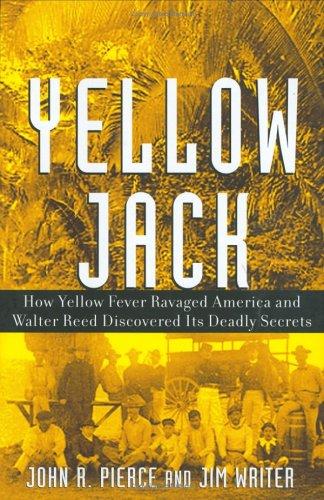
Yellow Jack
0
0
As an Amazon Associate and affiliate partner, Menrva Books earns from qualifying purchases. Learn more
Author Description
Like wars and natural disasters, epidemics tend to bring out both the best and the worst in people. Throughout most of its two-and-a-half-century killing spree across North America, yellow fever brought out only the worst. Characterized by seemingly random outbreaks that attacked people of all ages and walks of life, this excruciatingly painful and violent disease spread panic and chaos in communities that had weathered smallpox, typhoid, and other deadly epidemics with relative calm. Those who could run fled in every direction; parents abandoned infected children; friends and relatives shunned each other; businesses failed; governments collapsed; and thousands died in solitary agony with no one to care for them. Yellow Jack tracks the history of this deadly scourge from its earliest appearance in the Caribbean 350 years ago, telling the remarkable and triumphant story of a few extraordinarily brave souls who brought their very best to the battle against yellow fever. Based in large part on a massive body of research collected by Dr. Philip S. Hench, this thrilling medical adventure follows the exploits of the four-member US Army Yellow Fever Board, led by US Army major and physician Walter Reed. In the aftermath of the Spanish American war, the team assembled in Cuba -- long believed to be the fount of yellow fever -- on one of the most dangerous missions in medical history. Risking not only their own lives, but also those of the many volunteers who agreed to be infected with the virus, the team devised a series of elegantly simple experiments to pursue the disease as far as the science and technology of the era would allow. During their short stay in Cuba, these intrepid researchers overturned the leading theories of the day on the cause, spread, and control of yellow fever; they also presented sound new theories that were proven very quickly in practical application. By the end of 1901, Havana was free of yellow fever for the first time in 100 years. By 1905, the
Menrva's Summary
THE THESIS
Yellow fever, a disease that ravaged North America for centuries, brought out the worst in humanity, characterized by panic, abandonment, and societal collapse. The book traces the history of this devastating illness from its origins in the Caribbean, detailing its excruciating symptoms and the fear it instilled. It highlights the triumphant efforts of a few brave individuals who confronted the disease, focusing on the US Army Yellow Fever Board led by Walter Reed. Their dangerous mission in Cuba aimed to uncover the truth behind the epidemic, risking their lives and those of volunteers to conduct experiments that would challenge prevailing theories and ultimately lead to the disease's control.
THE SCOPE MAP
- The historical progression of yellow fever from its earliest appearances in the Caribbean.
- The societal impact of yellow fever, including panic, abandonment, and governmental collapse.
- The research and experiments conducted by the US Army Yellow Fever Board in Cuba.
- The scientific contributions of Walter Reed and his team in understanding the cause, spread, and control of yellow fever.
- The eventual eradication of yellow fever from Havana and its broader implications for public health.
THE AUTHORITY PERSPECTIVE
The book chronicles the history of yellow fever and the scientific efforts to combat it, presenting a narrative of human resilience and scientific triumph. It is based on extensive research, particularly the work of Dr. Philip S. Hench, and details the dangerous experiments undertaken by the US Army Yellow Fever Board in Cuba. The research presented led to a rapid understanding and control of the disease, notably freeing Havana of yellow fever by 1901. The authority perspective suggests this work offers a detailed account of a significant medical history event and the scientific breakthroughs that followed.
Page Count:
288
Publication Date:
2005-01-01
ISBN-10:
0471472611
ISBN-13:
9780471472612
Science
Non-Fiction
History
MEDICAL History
Public Health
Community Tags
Similar Books