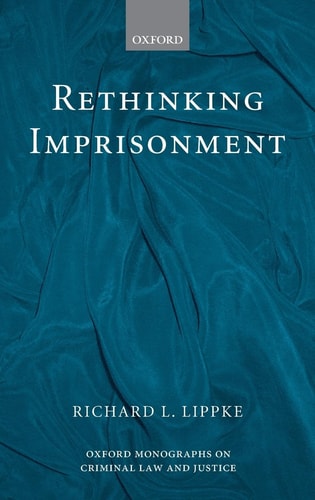
Rethinking Imprisonment: Oxford Monographs on Criminal Law and Justice
0
0
As an Amazon Associate and affiliate partner, Menrva Books earns from qualifying purchases. Learn more
Author Description
Drawing on philosophical arguments, criminological evidence, and the legal literature on prisoners' rights, Rethinking Imprisonment defends a normative theory of imprisonment. Such a theory provides an account of the justified conditions of prison confinement - the restrictions and deprivations that can be legitimately imposed on serious offenders in the name of punishment.The theory of legal punishment upon which this account builds combines retributive and crime reduction elements, with the former accorded priority on both moral and epistemic grounds. Contrary to its formidable reputation, retributivism is shown to place important and substantial limits on the character of imprisonment, its appropriate use, and duration. Much of the contemporary use of imprisonment as a legal sanction is arguably unjustified on all three counts.Rethinking Imprisonment urges the adoption of prison conditions at or near the 'minimum conditions of confinement' which severely curtail the freedom of movement, freedom of association, and privacy of prisoners, yet are still consistent with ensuring the basic physical and psychological welfare of prisoners, and provide them with access to paid labor, visitation, entertainment, recreation, and retained civic and political rights. This book argues that firstly the punishment of serious offenders generally requires no more than the imposition of 'minimum conditions of confinement' and secondly that moral constraints on punishment derived from retributivism in conjunction with the available evidence about the prison regimes most likely to reduce crime point towards more humane and less restrictive prisons.
Menrva's Summary
THE THESIS
This book investigates the moral and legal justifications for imprisonment, arguing that current penal practices often exceed the legitimate scope of state-sanctioned punishment. Richard L. Lippke, a scholar in legal and political philosophy, synthesizes criminological data with retributive theory to propose a normative framework for confinement. By prioritizing retributive constraints, the author challenges the necessity of harsh prison conditions and advocates for a model centered on minimum confinement standards that preserve basic human rights and welfare.
THE SCOPE MAP
What You Will Find
- A normative theory of imprisonment balancing retributive justice and crime reduction goals.
- An analysis of the legal and philosophical limits on state-imposed deprivations.
- A proposal for minimum conditions of confinement that retain civic and political rights.
- A critique of contemporary sentencing and prison regime practices based on moral and epistemic grounds.
THE AUTHORITY PERSPECTIVE
Legal scholars and criminologists frequently cite this work as a rigorous contribution to the debate on penal reform and the ethics of punishment. Readers often note the academic density of the prose, which is intended for an audience familiar with legal theory and criminal justice policy.
Page Count:
304
Publication Date:
2007-02-22
Publisher:
Oxford University Press
ISBN-10:
019920912X
ISBN-13:
9780199209125
Philosophy
Sociology
Imprisonment
Law
Criminology
Community Tags
Similar Books