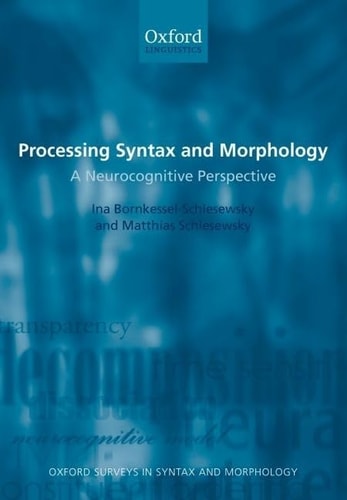
Processing Syntax and Morphology: A Neurocognitive Perspective (Oxford Surveys in Syntax & Morphology)
0
0
As an Amazon Associate and affiliate partner, Menrva Books earns from qualifying purchases. Learn more
Author Description
This book reviews interdisciplinary work on the mental processing of syntax and morphology. It focuses on the fundamental questions at the centre of this research, for example whether language processing proceeds in a serial or a parallel manner; which areas of the brain support the processing of syntactic and morphological information; whether there are neurophysiological correlates of language processing; and the degree to which neurolinguistic findings on syntactic and morphological processing are consistent with theoretical conceptions of syntax and morphology. The authors describe the outcomes of methods in neurophysiology (for example, functional magnetic resonance imaging), behavioural psycholinguistics, and neuropsychological lesion studies, and provide brief introductions to the methods themselves. They extend basic findings at the word and sentence level by considering how the mental processing of syntax and morphology relates to prosody, discourse, semantics, and world knowledge. They have divided the work into four parts concerned with word structure, sentence structure, processing syntax and morphology at the interfaces, and a comparison of different models of syntactic and morphological processing in the neurophysiological domain. The book is directed at graduate students and researchers in theoretical linguistics, psycho- and neurolinguistics, neurophysiology, and psychology.
Menrva's Summary
THE THESIS
This book investigates the neurocognitive mechanisms underlying the human processing of syntactic and morphological structures. Authors Ina Bornkessel-Schlesewsky and Matthias Schlesewsky synthesize interdisciplinary research to determine how the brain manages language at the word and sentence levels. By evaluating neurophysiological data alongside behavioral psycholinguistics, they examine whether language processing functions through serial or parallel operations and how these findings align with established theoretical linguistic models.
THE SCOPE MAP
What You Will Find
- Analysis of neurophysiological methods including functional magnetic resonance imaging and lesion studies.
- Examination of word structure and sentence structure processing within the brain.
- Investigation of language interfaces involving prosody, discourse, semantics, and world knowledge.
- Comparative evaluation of various models regarding syntactic and morphological processing.
THE AUTHORITY PERSPECTIVE
Experts recognize this work as a comprehensive resource for graduate students and researchers navigating the intersection of theoretical linguistics and neurophysiology. Readers frequently note the academic density of the prose, which serves as a rigorous introduction to current neurolinguistic methodologies.
Page Count:
320
Publication Date:
2009-09-21
Publisher:
Oxford University Press
ISBN-10:
0199207828
ISBN-13:
9780199207824
Psychology
Neuroscience
Linguistics
Academic
Community Tags
Similar Books