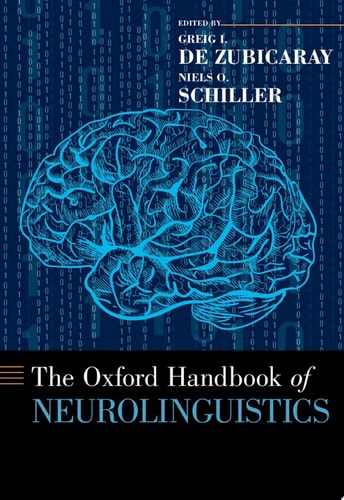
The Oxford Handbook of Neurolinguistics (Oxford Handbooks)
0
0
As an Amazon Associate and affiliate partner, Menrva Books earns from qualifying purchases. Learn more
Author Description
Neurolinguistics is a young and highly interdisciplinary field, with influences from psycholinguistics, psychology, aphasiology, and (cognitive) neuroscience, as well as other fields. Neurolinguistics, like psycholinguistics, covers aspects of language processing; but unlike psycholinguistics, it draws on data from patients with damage to language processing capacities, or the use of modern neuroimaging technologies such as fMRI, TMS, or both. The burgeoning interest in neurolinguistics reflects that an understanding of the neural bases of this data can inform more biologically plausible models of the human capacity for language.The Oxford Handbook of Neurolinguistics provides concise overviews of this rapidly-growing field, and engages a broad audience with an interest in the neurobiology of language. The chapters do not attempt to provide exhaustive coverage, but rather present discussions of prominent questions posed by given topics. The volume opens with essential methodological chapters: Section I, Methods, covers the key techniques and technologies used to study the neurobiology of language today, with chapters structured along the basic divisions of the field. Section II addresses the neurobiology of language acquisition during healthy development and in response to challenges presented by congenital and acquired conditions. Section III covers the many facets of our articulate brain, or speech-language pathology, and the capacity for language production-written, spoken, and signed. Questions regarding how the brain comprehends meaning, including emotions at word and discourse levels, are addressed in Section IV. Finally, Section V reaches into broader territory, characterizing and contextualizing the neurobiology of language with respect to more fundamental neuroanatomical mechanisms and general cognitive domains.
Menrva's Summary
THE THESIS
This volume investigates the neural mechanisms underlying human language processing by synthesizing data from cognitive neuroscience, aphasiology, and psycholinguistics. Editors Greig I. de Zubicaray and Niels O. Schiller compile contributions from leading researchers to establish a framework for understanding how biological structures support linguistic capacity. The text moves beyond theoretical speculation to examine how modern neuroimaging and clinical patient data inform current models of language production and comprehension.
THE SCOPE MAP
What You Will Find
- Methodological overviews of fMRI, TMS, and other neuroimaging technologies.
- Analysis of language acquisition in both healthy development and clinical conditions.
- Examination of speech-language pathology and production across spoken, written, and signed modalities.
- Investigations into semantic processing, emotional discourse, and neuroanatomical mechanisms.
Scope Limits
- The text does not provide exhaustive coverage of every sub-topic within the field.
- It focuses on prominent questions rather than serving as a comprehensive historical encyclopedia of linguistics.
THE AUTHORITY PERSPECTIVE
Experts and academics frequently cite this volume as a foundational reference for students and researchers entering the interdisciplinary field of neurolinguistics. Readers often note the high academic density of the prose, which is tailored for those already familiar with basic neurobiological and linguistic concepts.
Page Count:
989
Publication Date:
2019-01-01
Publisher:
Oxford University Press
ISBN-10:
0190914866
ISBN-13:
9780190914868
Psychology
Medical
Reference
English
Linguistics
Academic
Allied Health
Neuroscience
English & College Success
Community Tags
Similar Books