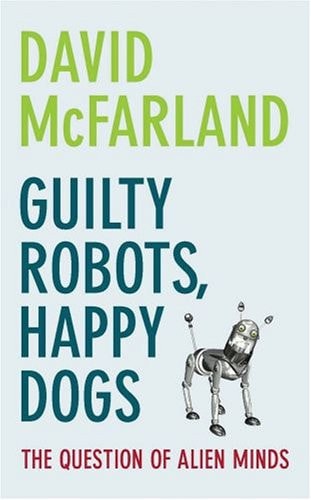
Guilty Robots, Happy Dogs: The Question of Alien Minds
0
0
As an Amazon Associate and affiliate partner, Menrva Books earns from qualifying purchases. Learn more
Author Description
When we interact with animals, we intuitively read thoughts and feelings into their expressions and actions. It is easy--often irresistible--to suppose that they have minds like ours. And as technology grows more sophisticated, we might soon find ourselves interpreting the behavior even of robots in human terms.But is our natural tendency to humanize other beings philosophically or scientifically justifiable? Can we ever know what non-human minds are really like? How different are human minds from the minds of animals or robots? In Guilty Robots and Happy Dogs, David McFarland offers an accessible exploration of these and many other intriguing questions, questions that illuminate our understanding the human mind and its limits in knowing and imagining other minds. In exploring these issues, McFarland looks not only at philosophy, but also examines new evidence from the science of animal behavior, plus the latest developments in robotics and artificial intelligence, to show how many different--and often quite surprising--conclusions we can draw about the nature of minds "alien" to our own. Can robots ever feel guilty? Can dogs feel happy? Answering these questions is not simply an abstract exercise but has real implications for such increasingly relevant topics as animal welfare, artificial intelligence, and cybernetics.Engagingly and accessibly written, and thought-provoking from start to finish, Guilty Robots and Happy Dogs touches on the very nature of mind and its evolution. It is essential reading for anyone curious about animal behavior, robotics, artificial intelligence, or the nature of the human mind.
Menrva's Summary
THE THESIS
This book investigates whether the human tendency to attribute consciousness and emotions to animals and machines is scientifically or philosophically valid. David McFarland, an expert in animal behavior, utilizes a multidisciplinary framework to examine the nature of non-human cognition. By synthesizing insights from philosophy, ethology, and artificial intelligence, he challenges the anthropomorphic assumptions that define our interactions with the world around us.
THE SCOPE MAP
What You Will Find
- Comparative analysis of human, animal, and artificial intelligence frameworks
- Philosophical inquiry into the nature of consciousness and subjective experience
- Scientific evidence from ethology and robotics research
- Practical implications for animal welfare and the future of cybernetics
THE AUTHORITY PERSPECTIVE
Experts and readers characterize this work as an accessible entry point into the complex intersection of cognitive science and philosophy. The text is noted for its ability to distill dense academic debates into clear, thought-provoking inquiries suitable for a general audience.
Page Count:
252
Publication Date:
2008-03-20
Publisher:
Oxford University Press
ISBN-10:
019921929X
ISBN-13:
9780199219292
Science
Philosophy
Consciousness
Robotics
Community Tags
Similar Books