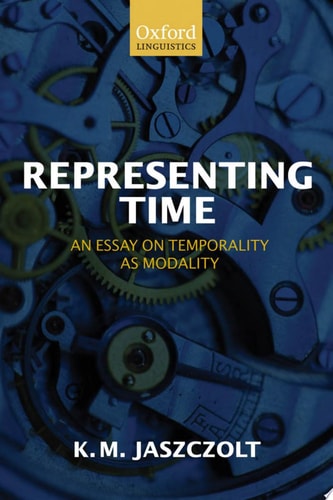
Representing Time: An Essay on Temporality as Modality
0
0
As an Amazon Associate and affiliate partner, Menrva Books earns from qualifying purchases. Learn more
Author Description
Thinking and speaking about time is ridden with puzzles and paradoxes. How do human beings conceptualize time? Why, for example, does the availability of tense vary in different languages? How do the lines of information from tense, aspect, temporal adverbs, and context interact in the mind? Does time describe events? If real time does not flow, where do the concepts of the past, present and future come from? Are they basic concepts or are they composed out of more primitive constituents? And, finally, what is the semantics of expressions with temporal reference? This book offers a new approach to the representation of meaning of temporally-located utterances and discourses. Temporality, the author suggests, should be taken to mean degrees of certainty, understood in turn as degrees of acceptability concerning the eventuality referred to in the speaker's utterance. She presents theoretical arguments and empirical evidence from Indo-European and non-Indo-European languages to show that speakers represent the past, present, and future as degrees of epistemic modality. She argues that temporality can be subsumed under the general label of acceptability or attitude and, rather like the semantic category of evidentiality, founded on the strength of evidence. In the approach she develops, modality provides basic conceptual building blocks for the concept of time and at the same time semantic building blocks for representing temporal expressions in her framework of Default Semantics. Dr Jaszczolt sets the results of her research in the context of linguistic and philosophical work in semantics and pragmatics.
Menrva's Summary
THE THESIS
This book investigates the fundamental question of how human beings conceptualize time by proposing that temporality is best understood as a form of epistemic modality. Dr. Kasia M. Jaszczolt, a scholar in the fields of semantics and pragmatics, utilizes a cross-linguistic analysis of Indo-European and non-Indo-European languages to support her argument. She posits that temporal expressions are not merely markers of chronological sequence but are instead representations of degrees of certainty and acceptability regarding an eventuality. By integrating her framework of Default Semantics, she demonstrates how modality serves as the conceptual and semantic foundation for temporal reference.
THE SCOPE MAP
What You Will Find
- Comparative analysis of temporal markers across diverse language families
- A theoretical framework for Default Semantics in temporal interpretation
- Empirical evidence linking tense, aspect, and temporal adverbs to epistemic modality
- Philosophical inquiry into the nature of past, present, and future as cognitive constructs
THE AUTHORITY PERSPECTIVE
Experts in the field of linguistics recognize this work as a significant contribution to the study of temporal semantics and the intersection of language and cognition. Readers frequently note the academic density of the prose, which is intended for researchers and advanced students interested in the formal representation of meaning.
Page Count:
320
Publication Date:
2009-05-15
Publisher:
Oxford University Press
ISBN-10:
0199214433
ISBN-13:
9780199214433
Philosophy
Semantics
Pragmatics
Linguistics
Community Tags
Similar Books