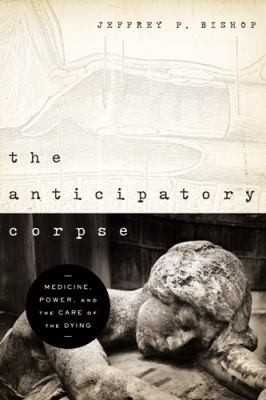
The Anticipatory Corpse: Medicine, Power, and the Care of the Dying
0
0
As an Amazon Associate and affiliate partner, Menrva Books earns from qualifying purchases. Learn more
Author Description
In this original and compelling book, Jeffrey P. Bishop, a philosopher, ethicist, and physician, argues that something has gone sadly amiss in the care of the dying by contemporary medicine and in our social and political views of death, as shaped by our scientific successes and ongoing debates about euthanasia and the "right to die"--or to live. _The Anticipatory Corpse: Medicine, Power, and the Care of the Dying, informed by Foucault's genealogy of medicine and power as well as by a thorough grasp of current medical practices and medical ethics, argues that a view of people as machines in motion--people as, in effect, temporarily animated corpses with interchangeable parts--has become epistemologically normative for medicine. The dead body is subtly anticipated in our practices of exercising control over the suffering person, whether through technological mastery in the intensive care unit or through the impersonal, quasi-scientific assessments of psychological and spiritual "medicine."The result is a kind of nihilistic attitude toward the dying, and troubling contradictions and absurdities in our practices. Wide-ranging in its examples, from organ donation rules in the United States, to ICU medicine, to_"spiritual surveys," to presidential bioethics commissions attempting to define death, and to high-profile cases such as Terri Schiavo's, The Anticipatory Corpse explores the historical, political, and philosophical underpinnings of our care of the dying and, finally, the possibilities of change. A ground-breaking work in bioethics, this book will provoke thought and argument for all those engaged in medicine, philosophy, theology, and health policy.With extraordinary philosophical sophistication as well as knowledge of modern medicine, Bishop argues that the body that shapes the work of modern medicine is a dead body. He defends this claim decisively with with urgency. I know of no book that is at once more challenging and informative as The Anticipatory Corps
Menrva's Summary
THE THESIS
Contemporary medicine's approach to the dying is fundamentally flawed, treating patients as anticipated corpses rather than living beings. Jeffrey P. Bishop, a philosopher, ethicist, and physician, argues that medicine has become epistemologically normative in viewing people as machines with interchangeable parts. This perspective, informed by Foucault's work on medicine and power, leads to a nihilistic attitude toward the dying, manifesting in technological control and impersonal assessments. The book examines historical, political, and philosophical underpinnings of end-of-life care, exploring possibilities for change through examples ranging from organ donation to bioethics commissions.
THE SCOPE MAP
- Analysis of Foucault's genealogy of medicine and power.
- Critique of the mechanistic view of the human body in contemporary medicine.
- Examination of technological control in intensive care units.
- Discussion of impersonal assessments in psychological and spiritual care.
- Case studies including organ donation rules, Terri Schiavo, and presidential bioethics commissions.
- Exploration of the historical, political, and philosophical dimensions of end-of-life care.
- Consideration of the possibilities for change in the care of the dying.
THE AUTHORITY PERSPECTIVE
This book is regarded as a significant contribution to bioethics, praised for its philosophical sophistication and deep knowledge of modern medicine. Critics note its challenging nature and informative scope, particularly its decisive and urgent defense of the claim that modern medicine operates with a conception of the body as already dead. The work is expected to provoke considerable thought and argument among professionals and academics in medicine, philosophy, theology, and health policy.
Page Count:
411
Publication Date:
2011-01-01
ISBN-10:
0268022275
ISBN-13:
9780268022273
Philosophy
Non-Fiction
Health
Medical Ethics
Sociology of Medicine
Bioethics
Death Studies
Community Tags
Similar Books