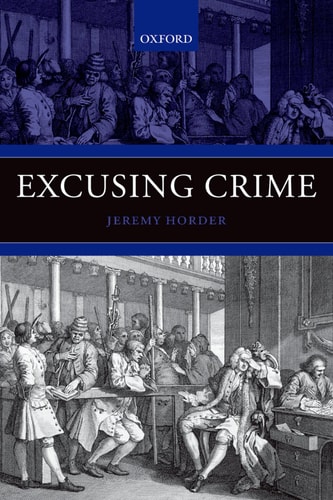
Excusing Crime
0
0
As an Amazon Associate and affiliate partner, Menrva Books earns from qualifying purchases. Learn more
Author Description
When should someone who may have intentionally or knowingly committed criminal wrongdoing be excused? Excusing Crime examines what excusing conditions are, and why familiar excuses, such as duress, are thought to fulfill those conditions.The 'classical' view of excuses sees them as rational defects (such as mistake) in the motive force behind an action, but contrasts them with 'denials of responsibility', such as insanity, where the rational defect in that motive force is attributable to a mental defect in the agent him- or herself. The classical view has a long heritage, and is enshrined in different forms in many of the world's criminal codes, both liberal and non-liberal; however, in this book, Jeremy Horder contends that it is now time to move beyond it.Horder then develops a 'liberal' account of excuses, arguing that the 'classical' distinction between rational defects and 'denials of responsibility' is too sharp, and its view of excuses is too narrow. He argues that it can be right to treat claims as excusatory even if they rely on a combination of elements of rational defect in the motive force behind the action, even if that defect is in part attributable to a mental deficiency in the agent him or herself ('diminished capacity'). Further, he believes that there can be a sound case for excuse even when people can give full rational assent to their actions, such as when they could not reasonably have been expected to do more than what they did to avoid committing wrongdoing ('due diligence'), or, more rarely, when their conscience understandably left them with no moral freedom to do other than commit the wrong ('demands-of-conscience').
Menrva's Summary
THE THESIS
This book investigates the philosophical and legal criteria that determine when an individual should be excused for intentional or knowing criminal wrongdoing. Jeremy Horder, a scholar in criminal law, challenges the traditional 'classical' view that strictly separates rational defects from denials of responsibility. By analyzing the limitations of existing criminal codes, he proposes a more flexible 'liberal' account of excuses that incorporates factors like diminished capacity and moral conscience.
THE SCOPE MAP
What You Will Find
- A critical evaluation of the classical distinction between rational defects and mental deficiencies.
- An analysis of the role of due diligence in excusing criminal behavior.
- A theoretical framework for understanding 'demands-of-conscience' as a valid excusatory condition.
- A comparative look at how liberal and non-liberal criminal codes handle responsibility and excuse.
THE AUTHORITY PERSPECTIVE
Legal scholars and practitioners frequently cite this work as a significant contribution to the philosophy of criminal law. The text is noted for its rigorous academic density and its challenge to established jurisprudential norms regarding agent responsibility.
Page Count:
318
Publication Date:
2007-05-17
Publisher:
Oxford University Press
ISBN-10:
0199225788
ISBN-13:
9780199225781
Philosophy
Legal Theory
Criminal Law
Law
Ethics
Community Tags
Other Editions(3)
Similar Books







Reader Comments
Share Your Thoughts
No comments yet. Be the first to share your thoughts!