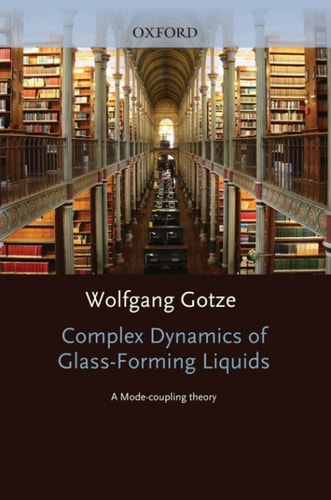
Complex Dynamics of Glass-Forming Liquids: A Mode-Coupling Theory
0
0
As an Amazon Associate and affiliate partner, Menrva Books earns from qualifying purchases. Learn more
Author Description
The book contains the only available complete presentation of the mode-coupling theory (MCT) of complex dynamics of glass-forming liquids, dense polymer melts, and colloidal suspensions. It describes in a self-contained manner the derivation of the MCT equations of motion and explains that the latter define a model for a statistical description of non-linear dynamics.It is shown that the equations of motion exhibit bifurcation singularities, which imply the evolution of dynamical scenarios different from those studied in other non-linear dynamics theories. The essence of the scenarios is explained by the asymptotic solution theory of the equations of motion. The leading-order results deal with scaling laws and the range of validity of these general laws is obtained by the derivation of the leading-correction results.Comparisons of numerical solutions of the MCT equations of motion with the results of the analytic results of the asymptotic analysis demonstrate various facets of the MCT dynamics. Some comparisons of MCT results with data are used to show the relevance of MCT for the discussion of amorphous matter dynamics.
Menrva's Summary
THE THESIS
This text investigates the fundamental mechanisms governing the complex dynamics of glass-forming liquids through the framework of mode-coupling theory (MCT). Wolfgang Götze, a prominent physicist in the field of condensed matter, provides a rigorous derivation of the equations of motion that describe the non-linear dynamics of dense polymer melts and colloidal suspensions. The work establishes a statistical model to explain how bifurcation singularities dictate the evolution of dynamical scenarios in amorphous matter.
THE SCOPE MAP
What You Will Find
- A comprehensive derivation of mode-coupling theory equations of motion.
- Asymptotic solution theory applied to non-linear dynamical systems.
- Analysis of scaling laws and leading-correction results for glass-forming liquids.
- Comparative studies between numerical solutions and experimental data for amorphous matter.
THE AUTHORITY PERSPECTIVE
Experts recognize this monograph as the definitive, foundational text for understanding mode-coupling theory in the context of glass transition physics. Readers frequently note the high level of mathematical density and technical rigor required to engage with the author's derivation of non-linear dynamical equations.
Page Count:
656
Publication Date:
2009-02-04
Publisher:
Oxford University Press
ISBN-10:
0199235341
ISBN-13:
9780199235346
Science
Statistical mechanics
Physics
Fluid dynamics
Thermodynamics
Condensed Matter Physics