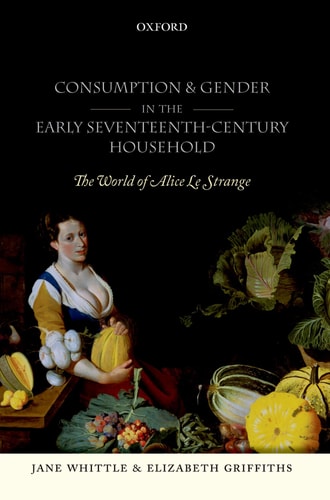
Consumption and Gender in the Early Seventeenth-Century Household: The World of Alice Le Strange
0
0
As an Amazon Associate and affiliate partner, Menrva Books earns from qualifying purchases. Learn more
Author Description
Lady Alice Le Strange of Hunstanton in Norfolk kept a continuous series of household accounts from 1610-1654. Jane Whittle and Elizabeth Griffiths have used the Le Stranges' rich archive to reconstruct the material aspects of family life. This involves looking not only at purchases, but also at home production and gifts; and not only at the luxurious, but at the everyday consumption of food and medical care.Consumption is viewed not just as a set of objects owned, but as a process involving household management, acquisition and appropriation, a process that created and reinforced social links with craftsmen, servants, labourers, and the local community. It is argued that the county gentry provide a missing link in histories of consumption: connecting the fashions of London and the royal court, with those of middling strata of rural England.Recent writing has focused upon the transformation of consumption patterns in the eighteenth century. Here the earlier context is illuminated and, instead of tradition and stability, we find constant change and innovation. Issues of gender permeate the study. Consumption is often viewed as a female activity and the book looks in detail at who managed the provisioning, purchases, and work within the household, how spending on sons and daughters differed, and whether men and women attached different cultural values to household goods. This single household's economy provides a window into some of most significant cultural and economic issues of early modern England: innovations in trade, retail and production, the basis of gentry power, social relations in the countryside, and the gendering of family life.
Menrva's Summary
THE THESIS
How did the household management and consumption patterns of the early seventeenth-century gentry shape the economic and social fabric of rural England? Elizabeth Griffiths and Jane Whittle utilize the extensive, continuous household accounts of Lady Alice Le Strange of Hunstanton, spanning from 1610 to 1654, to challenge the notion of domestic stability in the pre-eighteenth-century era. By analyzing the acquisition of goods, medical care, and food production, the authors argue that the gentry served as a crucial intermediary between the elite fashions of London and the rural middling strata, demonstrating a period defined by constant innovation rather than tradition.
THE SCOPE MAP
What You Will Find
- Detailed analysis of household accounts from the Le Strange family archive (1610-1654).
- Examination of gendered roles in provisioning, purchasing, and domestic labor management.
- Comparative study of expenditure patterns between sons and daughters within the gentry class.
- Investigation into the social and economic networks connecting the gentry to servants, laborers, and local craftsmen.
THE AUTHORITY PERSPECTIVE
Historians and scholars of early modern England recognize this work as a significant contribution to the study of material culture and gendered domestic economies. Readers frequently note the meticulous use of primary source archives to provide a granular view of seventeenth-century social relations and economic practices.
Page Count:
272
Publication Date:
2012-05-04
Publisher:
Oxford University Press
ISBN-10:
0199233535
ISBN-13:
9780199233533
History
Gender Studies
Consumption Economics
Domestic History
Economic History
Households
Great Britain
Social History
Community Tags
Similar Books