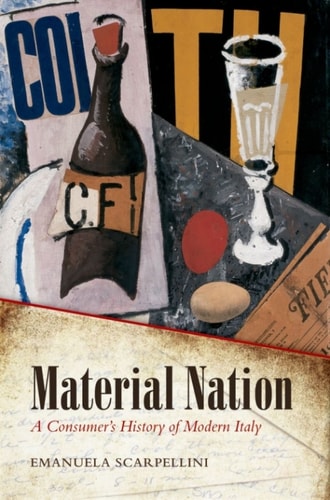
Material Nation: A Consumer's History of Modern Italy
0
0
As an Amazon Associate and affiliate partner, Menrva Books earns from qualifying purchases. Learn more
Author Description
In this fresh, unfamiliar, and sometimes surprising picture of modern Italy, history is refracted through the prism of the nation's consumer culture. What were Italians eating and drinking over this period? Where did they live? What did they do in their leisure time? What did they choose to spend their spare money on? And how did this differ between different economic classes and over time? From the battle against poverty conducted by the first liberal governments of a united Italy, to fascist autarchy, up to the emergence of welfare policies and today's multifaceted society, Scarpellini looks at how the material culture associated with consumption has structured Italian life and defined the boundaries of class, gender, generations, and regional differences, inspiring government policies, and influencing the worlds of art and literature. Keeping a constant eye on wider historical trends, both in Italy and internationally, the book looks at how the basic triad of consumer culture (food, housing, and clothing) slowly developed into a more complex pattern, incorporating transport, domestic appliances, and then electronics, communications, and fashion. Combining economic and cultural history with a vivid narrative style, this book is essential reading for anyone interested in the history of modern Italy and of consumption more generally in the last century and a half.
Menrva's Summary
THE THESIS
How has the evolution of consumer culture shaped the social, economic, and political identity of modern Italy from unification to the present day? Emanuela Scarpellini, a historian specializing in the social and cultural history of modern Italy, utilizes a multidisciplinary approach to examine the nation's development. By analyzing the shifting patterns of daily life—specifically food, housing, and clothing—she argues that consumer habits are not merely economic indicators but are fundamental drivers of class structure, gender roles, and regional identity. The text synthesizes archival research with broader historical trends to map the transition from early liberal governance through fascist autarchy to the contemporary welfare state.
THE SCOPE MAP
What You Will Find
- Analysis of the consumer triad: food, housing, and clothing.
- Examination of the impact of domestic appliances, transport, and electronics on Italian social life.
- Historical survey spanning from the late 19th century to the early 21st century.
- Integration of economic data with cultural artifacts from art and literature.
Scope Limits
- The text focuses primarily on the Italian peninsula, with limited comparative analysis of other Mediterranean nations.
- It does not provide an exhaustive technical economic report but rather a cultural history of consumption.
THE AUTHORITY PERSPECTIVE
Scholars and historians recognize this work as a significant contribution to the study of Italian social history, noting its ability to bridge the gap between economic data and cultural narrative. Readers frequently highlight the accessibility of the prose, which makes complex historical shifts in class and lifestyle clear to both academic and general audiences.
Page Count:
352
Publication Date:
2011-01-01
Publisher:
OUP Oxford
ISBN-10:
0192643282
ISBN-13:
9780192643285
History
Italy
Social History
Economic History
Cultural History
Consumption Economics
European History
Community Tags
Similar Books