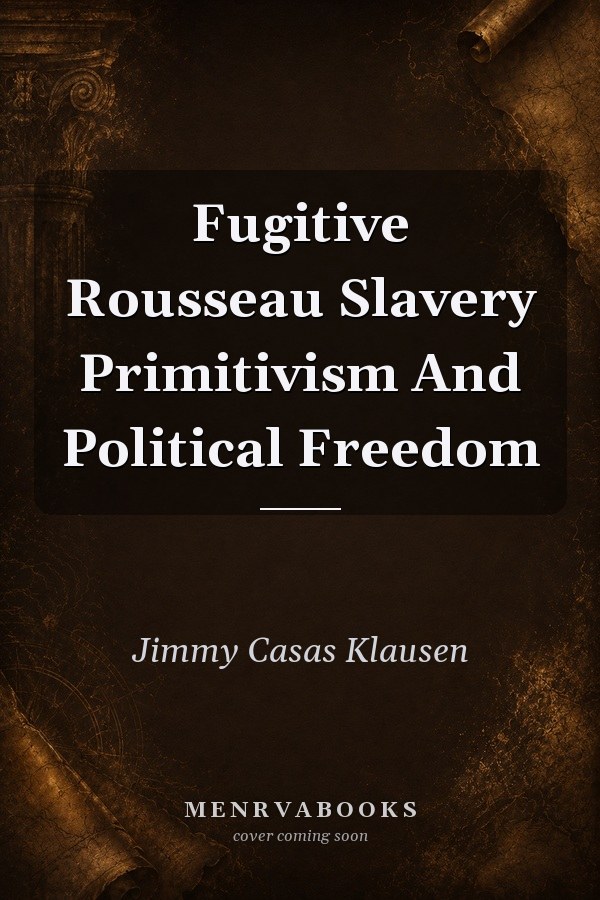
Fugitive Rousseau: Slavery, Primitivism, and Political Freedom
0
0
As an Amazon Associate and affiliate partner, Menrva Books earns from qualifying purchases. Learn more
Author Description
Critics have claimed that Jean-Jacques Rousseau was a primitivist who was uncritically preoccupied with "noble savages" and that he remained oblivious to the African slave trade. Fugitive Rousseau demonstrates why these charges are wrong and argues that a fresh, "fugitive" perspective on political freedom is bound up with the themes of primitivism and slavery in Rousseau's political theory. Rather than trace Rousseau's arguments primarily to the social contract tradition of Hobbes and Locke, Fugitive Rousseau places Rousseau squarely in two imperial contexts: European empire in his contemporary Atlantic world and Roman imperial philosophy. Anyone who aims to understand the implications of Rousseau's famous sentence "Man is born free, and everywhere he is in chains" or wants to know how Rousseauian arguments can support a radical democratic politics of diversity, discontinuity, and exodus will find Fugitive Rousseau indispensable
Menrva's Summary
THE THESIS
This book challenges conventional interpretations of Jean-Jacques Rousseau's political philosophy by re-examining his engagement with primitivism and slavery. It argues that a radical understanding of political freedom is intrinsically linked to these themes, moving beyond traditional social contract theories to place Rousseau within the imperial contexts of the Atlantic world and Roman philosophy. The work aims to illuminate Rousseau's ideas on freedom and chains, offering insights into democratic politics that embrace diversity and discontinuity.
THE SCOPE MAP
- Re-evaluation of Jean-Jacques Rousseau's political theory.
- Analysis of the interconnectedness of primitivism, slavery, and political freedom in Rousseau's work.
- Contextualization of Rousseau within the European empire of the Atlantic world.
- Exploration of Rousseau's engagement with Roman imperial philosophy.
- Critique of common claims that Rousseau was a naive primitivist unaware of the slave trade.
- Argument for a 'fugitive' perspective on political freedom.
- Discussion of Rousseau's implications for radical democratic politics.
THE AUTHORITY PERSPECTIVE
The book is presented as an indispensable resource for understanding Rousseau's complex ideas on freedom and chains, particularly for those interested in radical democratic politics. It aims to offer a fresh perspective by situating Rousseau within specific imperial contexts rather than solely within the social contract tradition. The work directly confronts critical claims about Rousseau's engagement with primitivism and slavery, proposing a reinterpretation of his political theory. Its arguments are designed to support a politics of diversity, discontinuity, and exodus.
Page Count:
333
Publication Date:
2014-01-01
ISBN-10:
0823257290
ISBN-13:
9780823257294
History
Philosophy
Non-Fiction
Science
Political Philosophy
Community Tags
Similar Books