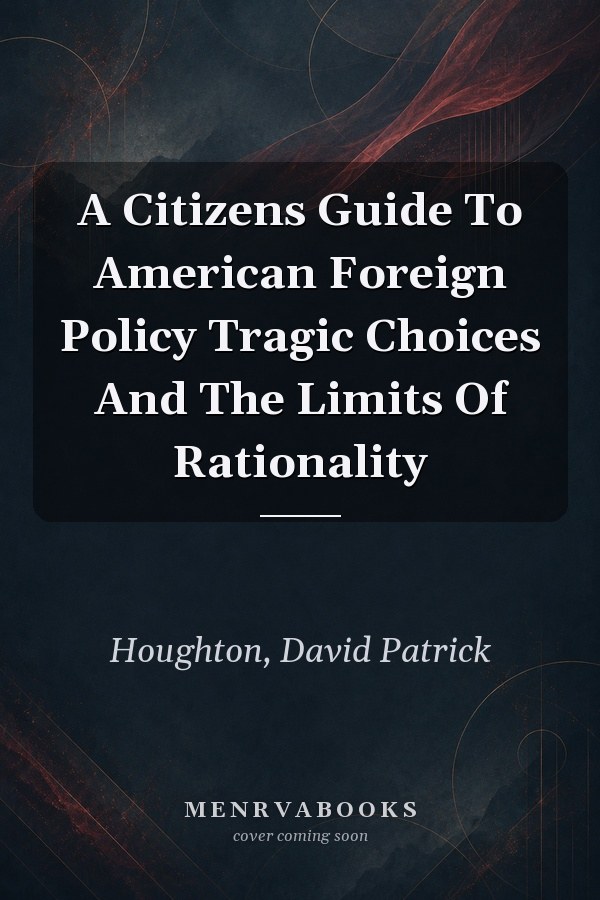
A Citizen's Guide to American Foreign Policy: Tragic Choices and the Limits of Rationality
0
0
As an Amazon Associate and affiliate partner, Menrva Books earns from qualifying purchases. Learn more
Author Description
American foreign policy often looks like a trail of man-made debris and disaster. Of course, the explanations for many poorly-made decisions are rather complex. In this brief and cogent analysis, Houghton shows us that understanding American foreign policy often comes down to recognizing the cognitive limitations of the decision-makers, which affects the foreign policy process. Then there is the nature of the decisions themselves. Quite a few decisions in American foreign policy involve 'tragic' choices, where leaders are effectively confronted with a series of progressively bad or uncomfortable options. And it is equally clear that some policies are not the product of any one individual's preferences, but emerge as a consequence of the way in which complex modern governments with large bureaucracies operate. Written with the interested layperson in mind, as well as students of international affairs, this Citizen's Guide to American Foreign Policy asks questions like, "Why do presidents so often do things which seem to be directly against the national interests of the United States - not just in retrospect, but even at the time?" "Why do there seem to be so many fiascoes in US foreign policy?" "Why does Congress sometimes tie the hands of the president in foreign affairs?" "Why do presidents seem to respond more to opinion polls or to what's on CNN and Fox News than they do to the core interests of the United States?" Houghton's overview helps us see past the partisan in-fighting that too often obscures the central issues in foreign affairs. This is vital, required reading for all readers who wish to better understand America's involvement in the world
Menrva's Summary
THE THESIS
This book investigates why American foreign policy frequently results in negative outcomes, despite the intentions of its decision-makers. David Patrick Houghton, an expert in international affairs, examines the cognitive limitations of leaders, the nature of 'tragic choices' where all options are undesirable, and the bureaucratic complexities of modern government as primary drivers of policy failures. The analysis aims to provide clarity beyond partisan debates, addressing why leaders might act against perceived national interests and why external factors like media coverage seem to influence decisions more than core interests.
THE SCOPE MAP
- Analysis of cognitive limitations affecting foreign policy decision-making.
- Exploration of 'tragic choices' and the dilemma of selecting the least bad option.
- Examination of how bureaucratic structures and government operations influence policy outcomes.
- Discussion on the perceived disconnect between US foreign policy actions and national interests.
- Inquiry into the role of media and public opinion in shaping foreign policy decisions.
- A framework for understanding foreign policy fiascoes and congressional-presidential dynamics.
THE AUTHORITY PERSPECTIVE
The book is presented as a cogent analysis for interested laypersons and students of international affairs, aiming to demystify the complexities of American foreign policy. It seeks to offer insights into recurring issues such as policy failures and the influence of external factors on decision-making. The author's approach is designed to cut through partisan rhetoric to reveal underlying structural and cognitive reasons for policy outcomes. The work is positioned as essential reading for those seeking a deeper understanding of America's global role.
Page Count:
152
Publication Date:
2013-01-01
ISBN-10:
0415844088
ISBN-13:
9780415844086
Politics
Science
Non-Fiction
Cognitive Psychology
International relations
Foreign Policy
Community Tags
Similar Books