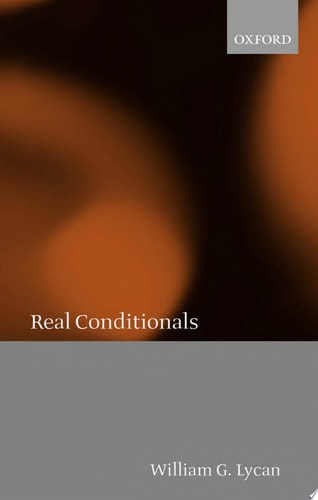
Real Conditionals
0
0
As an Amazon Associate and affiliate partner, Menrva Books earns from qualifying purchases. Learn more
Author Description
Logicians have written a great deal on the semantics of conditional sentences. This book contends that insufficient attention has been paid to the syntax of conditionals, as investigated by linguists. Syntactic data are used to make the case that "If"-clauses tacitly quantify over items called "events," "circumstances," or "conditions." This motivates a semantic theory of conditionals that concentrates on "only if," "even if" and "unless" as well as on "If...then." The theory is then applied to a number of examples from the literature, and its predictions and successes compare favorably to those of competing semantic theories.
Menrva's Summary
THE THESIS
This book investigates the syntactic structure of conditional sentences to argue that 'if'-clauses function as tacit quantifiers over events, circumstances, or conditions. William G. Lycan, a prominent philosopher of language, utilizes linguistic data to challenge existing semantic models that prioritize logic over syntax. By shifting the focus toward the grammatical behavior of conditionals, the author proposes a robust semantic framework that accounts for complex constructions like 'only if,' 'even if,' and 'unless.'
THE SCOPE MAP
What You Will Find
- Analysis of the syntactic properties of conditional sentences
- A semantic theory centered on quantification over events and circumstances
- Comparative evaluation of 'if...then' versus 'only if,' 'even if,' and 'unless' constructions
- Application of the proposed theory to existing examples from philosophical and linguistic literature
THE AUTHORITY PERSPECTIVE
Experts recognize this work as a significant contribution to the intersection of formal semantics and syntactic theory. Scholars frequently note the technical precision of the arguments and the clarity with which Lycan addresses long-standing problems in the analysis of conditional logic.
Page Count:
240
Publication Date:
2001-11-08
Publisher:
Clarendon Press
ISBN-10:
0199242070
ISBN-13:
9780199242078
Philosophy
Semantics
Syntax
Logic
Linguistics
Community Tags
Similar Books