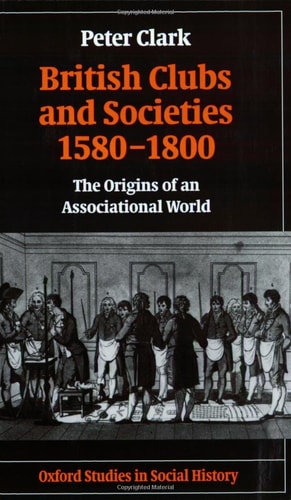
British Clubs and Societies 1580-1800: The Origins of an Associational World
0
0
As an Amazon Associate and affiliate partner, Menrva Books earns from qualifying purchases. Learn more
Author Description
This book provides the first account of the rise of these most distinctive, widespread and powerful of social institutions in Georgian Britain. With roots in the early modern era, British clubs and societies swept the country by 1800, when they numbered in the thousands, and their influence continues today. Looking at the complex mosaic of clubs and societies, ranging from freemasonry to bird-fancying, the author considers the reasons for their successful development, their export to America and the colonies, and their impact on British Society.
Menrva's Summary
THE THESIS
This work investigates the historical emergence and rapid proliferation of clubs and societies in Britain between 1580 and 1800, questioning how these institutions transformed the social landscape. Peter B. Clark, a noted historian of early modern Britain, utilizes extensive archival research to trace the evolution of associational life from its nascent stages to its status as a dominant cultural force. He argues that these organizations were fundamental to the development of civil society, providing a framework for public interaction that transcended traditional class and religious boundaries.
THE SCOPE MAP
What You Will Find
- A comprehensive historical analysis of British social institutions from the late sixteenth to the early nineteenth century.
- Examination of diverse organizational types, including freemasonry, professional guilds, and recreational hobbyist groups.
- Evidence derived from primary source records, local archives, and contemporary societal documentation.
- An assessment of the global influence of British associational models, particularly their expansion into American and colonial territories.
THE AUTHORITY PERSPECTIVE
Historians recognize this text as a foundational study for understanding the structural development of Georgian society. Scholars frequently cite the work for its meticulous documentation and its significant contribution to the study of early modern social networks.
Page Count:
548
Publication Date:
2002-02-02
Publisher:
Oxford University Press
ISBN-10:
0199248435
ISBN-13:
9780199248438
History
Great Britain
Associations institutions
Men
Sociology
British History
Social History