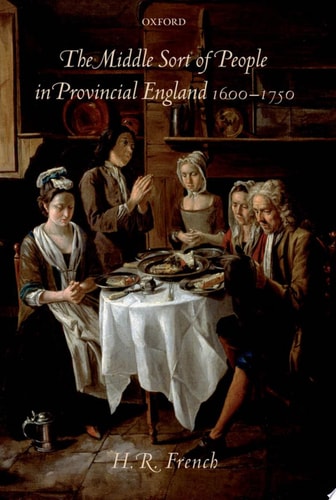
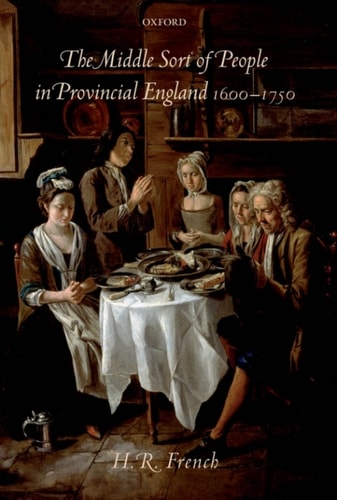
The Middle Sort of People in Provincial England, 1600-1750
0
0
As an Amazon Associate and affiliate partner, Menrva Books earns from qualifying purchases. Learn more
Author Description
Exploring the origins of 'middle-class' status in the English provinces during a formative period of social and economic change, this book provides the first comparative study of the nature of social identity in early modern provincial England. It questions definitions of a 'middling' group, united by shared patterns of consumption and display, and examines the bases for such identity in three detailed case studies of the 'middle sort' in East Anglia, Lancashire, and Dorset. Dr. French identifies how the 'middling' described their status, and examines this through their social position in parish life and government, and through their material possessions.Instead of a coherent, unified 'middle sort of people' this book reveals division between self-proclaimed parish rulers (the 'chief inhabitants') and a wider body of modestly prosperous householders, who nevertheless shared social perspectives bounded within their localities. By the eighteenth century, many of these 'chief inhabitants' were trying to break out of their parish pecking orders - not by associating with a wider 'middle class', but by modifying ideas of gentility to suit their circumstances (and pockets).French concludes as a result, that while the presence of a distinct 'middling' stratum is apparent, the social identity of the people remained fragmented - restricted by parochial society on the one hand, and overshadowed by the prospect of gentility on the other. He offers new interpretation and insights into the composition and scale of the society in early modern England.
Menrva's Summary
THE THESIS
This book investigates the origins and nature of the 'middle-class' identity in provincial England between 1600 and 1750. Dr. H. R. French, a specialist in early modern social history, utilizes a comparative framework to challenge the notion of a unified 'middling' social group. By analyzing the intersection of parish governance, material culture, and social status, the author argues that identity during this period was fragmented by local parochial boundaries and the aspirational pull of gentility.
THE SCOPE MAP
What You Will Find
- Comparative analysis of social identity in East Anglia, Lancashire, and Dorset.
- Examination of the distinction between 'chief inhabitants' and modest householders.
- Analysis of parish records, government participation, and material possession inventories.
- Evaluation of how social status was defined and performed within local communities.
THE AUTHORITY PERSPECTIVE
Historians and scholars of the early modern period recognize this work as a significant contribution to the study of social stratification in England. Readers frequently note the academic density of the prose and the rigorous use of primary source case studies to dismantle simplified historical narratives regarding the rise of the middle class.
Page Count:
320
Publication Date:
2007-08-30
Publisher:
Oxford University Press
ISBN-10:
0199296383
ISBN-13:
9780199296385
History
Great Britain
Sociology
Social History
England
British History
Community Tags
Other Editions(2)
Similar Books