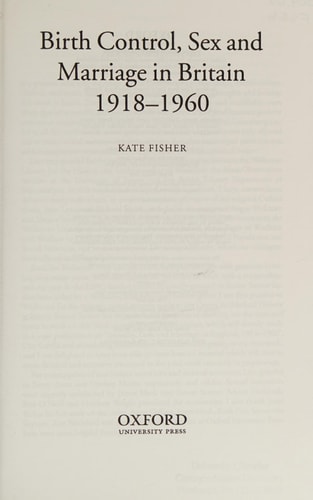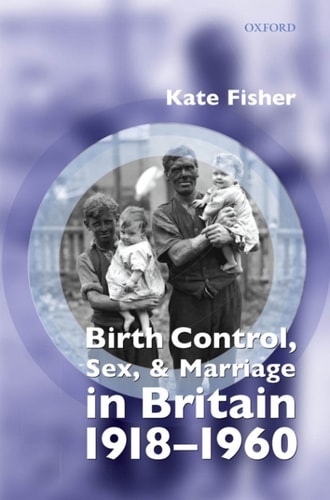
Birth Control, Sex, and Marriage in Britain 1918-1960
0
0
As an Amazon Associate and affiliate partner, Menrva Books earns from qualifying purchases. Learn more
Author Description
The first half of the twentieth century witnessed a revolution in contraceptive behaviour as the large Victorian family disappeared. This book offers a new perspective on the gender relations, sexual attitudes, and contraceptive practices that accompanied the emergence of the smaller family in modern Britain. Kate Fisher draws on a range of first-hand evidence, including over 190 oral history interviews, in which individuals born between 1900 and 1930 described their marriages and sexual relationships. By using individual testimony she challenges many of the key conditions that have long been envisaged by demographic and historical scholars as necessary for any significant reduction in average family size to take place. Dr Fisher demonstrates that a massive expansion in birth control took place in a society in which sexual ignorance was widespread; that effective family limitation was achieved without the mass adoption of new contraceptive technologies; that traditional methods, such as withdrawal, abstinence, and abortion were often seen as preferable to modern appliances, such as condoms and caps; that communication between spouses was not key to the systematic adoption of contraception; and, above all, that women were not necessarily the driving force behind the attempt to avoid pregnancy. Women frequently avoided involvement in family planning decisions and practices, whereas the vast majority of men in Britain from the interwar period onward viewed the regular use of birth control as a masculine duty and obligation. By allowing this generation to speak for themselves, Kate Fisher produces a richer understanding of the often startling social attitudes and complex conjugal dynamics that lay behind the vast changes in contraceptive behaviour and family size in the twentieth century.
Menrva's Summary
THE THESIS
This book investigates the social and personal dynamics that facilitated the decline of the large Victorian family in Britain between 1918 and 1960. Kate Fisher, a historian specializing in modern British social history, utilizes a qualitative approach to challenge established demographic theories regarding family limitation. By analyzing individual testimonies, she argues that the transition to smaller families occurred independently of modern contraceptive technology and was driven by complex, often counter-intuitive, gendered negotiations within marriage.
THE SCOPE MAP
What You Will Find
- Analysis of oral history interviews with over 190 individuals born between 1900 and 1930.
- Examination of the role of traditional contraceptive methods such as withdrawal, abstinence, and abortion.
- Investigation into the division of labor and decision-making processes regarding family planning within working-class and middle-class marriages.
Scope Limits
- The study focuses specifically on the British experience and does not provide a comparative analysis of contraceptive trends in other nations.
- The research is limited to the perspectives of individuals born in the early twentieth century and does not extend into the post-1960 sexual revolution.
THE AUTHORITY PERSPECTIVE
Historians and sociologists frequently cite this work for its innovative use of oral history to dismantle long-standing assumptions about twentieth-century reproductive behavior. Experts highlight the text as a significant contribution to the field for its nuanced portrayal of masculine responsibility in family planning.
Page Count:
304
Publication Date:
2006-01-01
Publisher:
Oxford University Press
ISBN-10:
0191533068
ISBN-13:
9780191533068
History
Great Britain
Sociology
Social History
Family Size
British History
Womens Studies
European History
Gender Studies
Sex Role