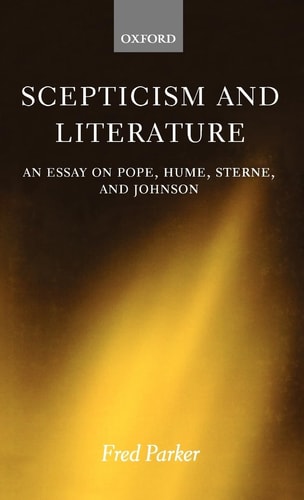
Scepticism and Literature: An Essay on Pope, Hume, Sterne, and Johnson
0
0
As an Amazon Associate and affiliate partner, Menrva Books earns from qualifying purchases. Learn more
Author Description
In this first study of the role of scepticism in literature, Fred Parker offers a lively and stimulating introduction to key issues in eighteenth-century literature and philosophy. Parker traces the presence of sceptical thinking in works by Pope, Hume, Sterne, and Johnson, relates it more broadly to the social self-consciousness of eighteenth-century culture, and discusses its source in Locke and its inspiration in Montaigne.
Menrva's Summary
THE THESIS
This work investigates the intersection of philosophical scepticism and literary expression within the intellectual landscape of the eighteenth century. Fred Parker, a scholar of English literature, examines how the epistemological uncertainties introduced by thinkers like Locke and Montaigne permeated the creative output of major writers. By analyzing the works of Pope, Hume, Sterne, and Johnson, Parker argues that scepticism was not merely a philosophical stance but a fundamental component of the era's social self-consciousness and literary form.
THE SCOPE MAP
What You Will Find
- Analysis of the influence of John Locke and Michel de Montaigne on eighteenth-century thought.
- Detailed literary criticism of Alexander Pope, David Hume, Laurence Sterne, and Samuel Johnson.
- Exploration of the relationship between philosophical doubt and the development of the social self.
- Examination of how sceptical inquiry shapes narrative structure and rhetorical style in the period.
THE AUTHORITY PERSPECTIVE
Scholars frequently cite this text as a significant contribution to the study of the intellectual history of the Enlightenment. Experts highlight the clarity with which Parker bridges the gap between abstract philosophical inquiry and the practical application of these ideas in canonical literature.
Page Count:
304
Publication Date:
2003-12-11
Publisher:
Oxford University Press
ISBN-10:
0199253188
ISBN-13:
9780199253180
Non-Fiction
Philosophy
Eighteenth Century
Skepticism
Literary Criticism
Community Tags
Similar Books