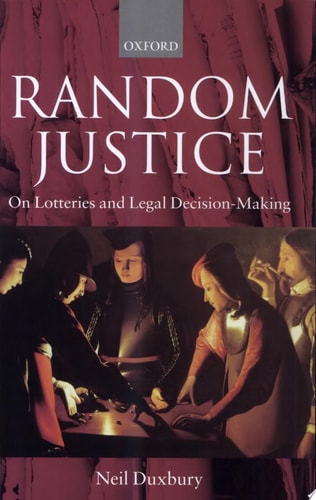
Random Justice: On Lotteries and Legal Decision-Making
0
0
As an Amazon Associate and affiliate partner, Menrva Books earns from qualifying purchases. Learn more
Author Description
This controversial book explores the potential for the use of lotteries in social, and particularly legal, decision-making contexts. Neil Duxbury considers in detail the history, advantages, and drawbacks of deciding issues of social significance by lot and argues that the value of the lottery as a legal decision-making device has generally been underestimated.
Menrva's Summary
THE THESIS
This book investigates the historical and contemporary viability of utilizing lotteries as a legitimate mechanism for resolving complex legal and social decision-making problems. Neil Duxbury, a scholar of legal theory, examines the historical precedents of sortition and random selection to challenge the modern assumption that judicial or administrative discretion is always superior to chance. By analyzing the philosophical underpinnings of fairness and impartiality, the author argues that lotteries offer a unique, often overlooked solution to systemic bias and decision-making gridlock.
THE SCOPE MAP
What You Will Find
- Historical analysis of sortition in ancient and modern legal systems
- Comparative evaluation of random selection versus deliberative decision-making
- Theoretical framework for assessing the fairness of procedural outcomes
- Case studies illustrating the practical application of lotteries in social governance
THE AUTHORITY PERSPECTIVE
Legal scholars and political theorists frequently cite this work as a rigorous examination of an unconventional procedural tool. Experts highlight the text for its academic depth and its ability to provoke critical debate regarding the foundations of institutional justice.
Page Count:
192
Publication Date:
2002-11-28
Publisher:
Oxford University Press
ISBN-10:
0199253536
ISBN-13:
9780199253531
Philosophy
Law
Sociology
Legal Theory
Justice Administration of
Lotteries
Decision Making
Community Tags
Similar Books