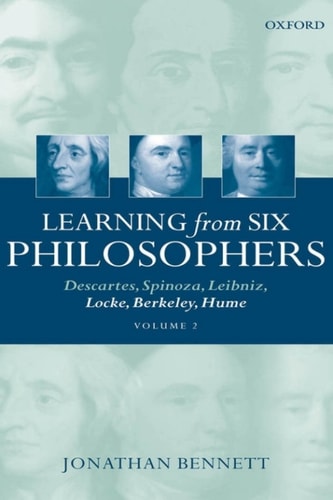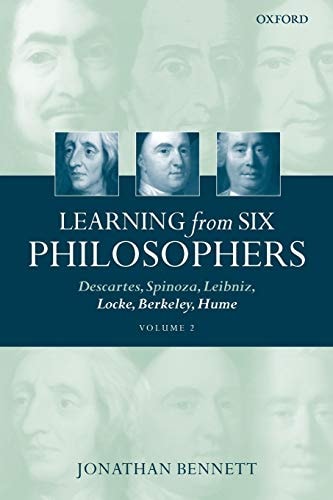
Learning from Six Philosophers: Descartes, Spinoza, Leibniz, Locke, Berkeley, Hume, Volume 2
0
0
As an Amazon Associate and affiliate partner, Menrva Books earns from qualifying purchases. Learn more
Author Description
Jonathan Bennett engages with the thought of six great thinkers of the early modern period: Descartes, Spinoza, Leibniz, Locke, Berkeley, and Hume. While not neglecting the historical setting of each, his chief focus is on the words they wrote. What problem is being tackled? How exactly is the solution meant to work? Does it succeed? If not, why not? What can be learned from its success or failure? For newcomers to the early modern scene, this clearly written work is an excellent introduction to it. Those already in the know can learn how to argue with the great philosophers of the past, treating them as colleagues, antagonists, students, teachers. In this second volume, Bennett focuses on the work of Locke, Berkeley, and Hume.
Menrva's Summary
THE THESIS
This volume investigates the core philosophical arguments of Locke, Berkeley, and Hume to determine the validity and logical success of their proposed solutions to early modern problems. Jonathan Bennett, a prominent scholar in the field of early modern philosophy, utilizes a rigorous analytical approach to dissect the primary texts of these three thinkers. By treating these historical figures as active participants in a contemporary dialogue, the author evaluates their reasoning processes and identifies the strengths and weaknesses inherent in their philosophical systems.
THE SCOPE MAP
What You Will Find
- Detailed critical analysis of the works of John Locke, George Berkeley, and David Hume.
- Methodological framework for engaging with historical texts as active, logical arguments.
- Evaluation of the success or failure of specific philosophical propositions within the early modern context.
- Pedagogical approach that balances historical setting with contemporary argumentative critique.
THE AUTHORITY PERSPECTIVE
Experts and students alike recognize this work as a foundational text for developing critical engagement with early modern philosophy. Readers frequently note the clarity of Bennett's prose, which makes complex metaphysical and epistemological arguments accessible to those new to the subject while remaining intellectually rigorous for advanced scholars.
Page Count:
375
Publication Date:
2003-12-11
Publisher:
Oxford University Press
ISBN-10:
0199266298
ISBN-13:
9780199266296
Non-Fiction
Philosophy
Epistemology
Metaphysics
Philosophers